
Question:1) Write the number of vertical columns in modern periodic table. What are these columns called?
Answer: There are 18 vertical columns in the modern periodic table. Each vertical column is called a group.
Note: All elements in a group have similar physical and chemical properties because they have the same number of valence electrons.
Question:2)Give the respective scientific terms used for studying:
(i) the mechanism by which variations are created and inherited and
(ii) the devlopment of new type of organisms from the existing ones.
Solution: (i) Genetics is the scientific term used in the biology for studying the mechanism by which variations are created and inherited.
(ii) Evolution is the scientific term used in the biology for studying the devlopment of new type of organisms from the existing ones.
Question:3) Water is a valuable resource. List two ways that you would suggest every family member to save this resource.
Solution:
Neccessity of water :
1)It provides medium to carry out all the cellular processes. It is a natural solvent.
2)All the reactions that occur in our body and within cells occur between substances that are dissolved in water.
3)It is required for the transportation of materials from one part of the body to the other.
4)lt helps to maintain living body as well as Earth’s temperature.
5)Water makes up about 7o % of body weight of all the living organisms.
Following are the methods that every family member can implement for saving water resources:
(i) Reduce: Minimize the over usage by avoiding leakage etc.
(ii) Reuse: Motivate people for reusing the same water for other purposes.
(iii) Recycle: Sewage water can be treated in sewage treatment plant and can be reutilize for other various purposes.
(iv) Refuse: Refuse waste of water. For eg avoid or refuse excessive use of water in family gatherings, community functions and festivals(Holi,diwali etc.)
(v) Recover: water can be recover by various methods like rain water harvesting, water shed management, Increase the forest cover(afforestation) etc.
Question:4)List 4 advantages of Vegetative propagation.
Solution:
Following are the advantages of Vegetative Propagation:
1) Plants which do not produce seeds, are propagated by this method for eg. Sugar-cane, banana, potato, rose, orange, seedless grapes, jasmines etc.
2) Vegetative propagation is a cheaper, easier and more rapid method of propagation in plants than growing plants from their seed.
3) The traits (Character) of a plants is preserved by vegetative propagation.
4)The plants generated from vegetative means requires less time to grow and have the advantages of being more uniform and genetically similar to parent plant.
5) In this method,the plant skip the risky seedling stage in which a number of plants die.
Question:4) Why is Govt. of india imposing a ban on the use of polythene bags. Suggest two alternatives to these bags and explain how this ban is likely to improve the environent.
Solutions: Following are the reasons for imposing ban on the use of polythene bags by Government:
1) Polythene bags are non-biodegradable in nature. It means that polythene bags do not decompose in nature.
2) Polythene bags clog drainage area(gutter), sewage pipe-lines, etc.
3) If polythene bags is ingested by the animals, it enters in the digestive tract of these animals and pose a great threat to their life.
4) If polythene bags enter into the stream or water body ,It can be a severe threat to the lives of the aquatic animals.
Banning of Polythene bags will help the environment by reducing space in landfills (plastic takes a long time to decompose in landfills), also it is made from petrolieum so if we stop using it , we reduce our need for oil.
Alternative to Polythene bags are:
1) Paper Bags, Cotton Clothe bags
2) Jute bags
Question:6) What is meant by biodiversity? List two advantages of conserving forest and wild life.
Solution: Biodiversity is the variety of life on Earth which includes number of different species of plants and animals in an environment.
Following are the advantages of conserving forest and Wild life.
(i)Forests influence the climate and rainfall of tge particular place.
(ii) Forests prevent soil erosion and floods.
(iii)Forests provide habitat for many living organisms.
(iv)Forests provide many products like wood , rubber, resins, fibres, food, medicines etc.
(v) Wild life give us food also used for recreational activities
(vi) Conservation of wild life give way to ecotourism.
(vii) Wildlife conservation will have good effect on other resources of the ecosystem.
Question:7) State the meaning of functional group in carbon compound. Write the functional group present in (i) ethanol (ii) ethanoic acid and also draw their structures.
Solution: An atom or group which determine the chemical properties of organic compounds are called functional groups.
Ethanol =CH3-CH2-OH
The general formula of alcohol is
R-OH where ‘R’ is an alkyl group and
–OH is the functional group.
Ethanoic Acid = CH3-COOH
The general formula of alcohol is
R-OH where ‘R’ is a hydrogen atom or
alkyl group and –COOH is the functional
group.
Question:8) Write the name and general formula of a chain of hydrocarbons in which an addition reaction takes place. Stating the essential conditions required for an addition reaction to occur, write the chemical equation giving the name of the reactant and the product of the such reaction.
Solution:
The Name of hydrocarbons that undergo addition reactions with H2 are:
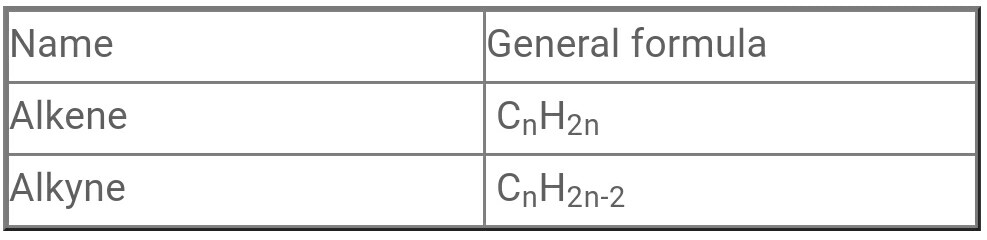
The essential conditions for addition reaction are:
(i) Presence of multiple bonds (double or triple bonds) between carbon atoms in the chain of hydrocarbons.
(ii) The addition of hydrogen should be carried out in the presence of catalyst such as Nickel and Platinum.
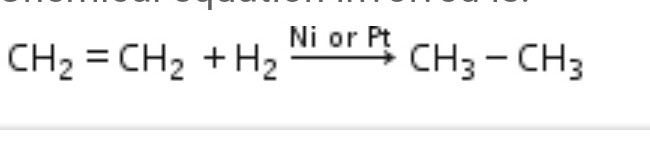
Reactant = Ethene
Product = Ethane
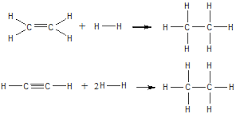
Reaction of Alkene:
Addition of hydrogen to Ethene produce Ethane which is an Alkane.
Reaction of Alkyne:
Addition of hydrogen to Ethyne produce Ethane which is also a Alkane. But the difference is it requires two moles of H2.
The Chemical equation with bond is shown below

 Apex Class
Leave a comment