
Question:1) What is Speciation ?
Question:2) Why should bio-degradable and non-biodegadable waste be discard in two separate dust bins ?
Question:3)”The chromosomes numbers of sexually reproducing parents and their offspring is the same.”Justify this statement.
Question:4) We often observe domestic waste decomposing in the lanes of residential colonies.Suggest ways to make people realise that the improper disposal of waste is harmful to the environment.
Question:5).List and explain any two advantages associated with the water harvesting at the community level.
Question:6).a)Explain the process of regeneration in planaria.
b)How is generation different from reproduction ?
Question:7).Write two example each of sexually transmitted disease caused by
1.Virus
2.Bacteria
Explain how the transmission of such disease be prevented.
Question:8).Tabulate two distinguishing features between acquired traits and inherited traits with one example of each.
Question:9).”The sex of new born child is a matter of chance and none of the parents may be considered responsible for it.”Justify this statement with the help of flow chart showing determination of sex of a newborn.
Question:10)a) What is an ecosystem ?List its two main components.
b)Why do not clean ponds or lakes,but an aquarium need to be clean regularly.Explain.
Question:11).a)List three distinguishing features between sexual and asexual types of reproduction.
b)Explain why variations are observed in the offspring of sexually reproducing organisms ?
Question:12).State one fuction of iris in human eye.
Question:13).Name an organism which reproduce by spore formation.List three conditions favourable for spores to germinate and grow.
Question:14).State the role of placenta in the development of Embryo.
Question:15).List three problem which arrise due to construction of big dams.Suggest a solution for these problems.
Question:16).List the products of combustion of fossil fuels.What are their adverse effect on the environment.
Question:17.List and explain in brief three methods of contraception.
Question:18).If we cross pure breed tall(dominant) pea plant with pure breed dwarf(recessive) pea plants of F1 generation but appeared in F2 generation.
a)What do plants of F1 generation look like ?
b)State the type of plants not found in F1 generation but appeared in F2 generation, mentioning the reason for the same.
c)State the ratio of tall plants to dwarf plants in F2 generation.
Question:19).How are fossils formed ? Describe,in brief two methods of determining the age of fossils.
Question:20).In a food chain, if 10,000 joules of energy is available to the producer,how much energy will be available to the producer,how much energy will be available to the secondary consumer to transfer it to tertiary consumer?
Question:21).Write the full form of DNA. Name the part of the cell where it is located.Explain its role in the process of reproduction of the cell.
Question:22).Explain in the phenomenon of “biological magnification.”How does it effect organisms belong to different tropical levels.Particularly the tertiary consumers ?
Question:23).Explain the process of digetion of mouth,stomach and small intestine in human body.
Question:24).a)List the three events that occur during the process of photosynthesis.Explain the role of stomata in this process.
b)Describe an experiment to show that “sun light is essential for photosynthesis.”
Question:25).Draw a diagram of longitudnal section of a flower and label on it sepal,petal,ovary, and the stigma.
b)Write the names of male and female reproductive parts of flower.
Question:26)What is the fragmentation in organisms ? Name a multicellular organisms which reproduces by this method.
b)What is the regeneration in the organisms? Describe regenration in planaria with the help of suitable diagram.
Question:27)a)Explain the term “self pollination” and “cross pollination” ?
b)How do the insects help in cross pollination.
c)How is the process of pollination different from fertilization?
Question:28).Define evolution ? State Darwin’s theory of evolution ?
b)In what ways is analogus organs evidence for evolution?
c)Define speciation? Explain how does speciation occurs?
Question:29)”A trait may be inherited , but may not be expressed.”Justify this statement with the help of suitable example.
Question:30).Draw a sectional view of human female reproductive system and label the part where :
a)Egg develops.
b)Fertilisation takes place.
c)Fertiled eggs gets implanted
Question:31).Describe in brief the changes the uterus undergoes.
a)To recieve the zygote.
b)If zygote is not formed.
Question:32).a)Name the parts labelled as A,B,C and D in the diagram given below :
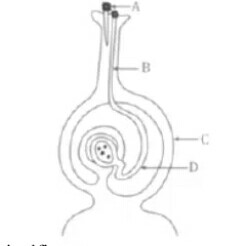
b)What is pollination ? State its significance.
c)How does fertilisation occurs in flowers? Name the parts of flower that develop into:
i)seed
ii)Fruit after fertilisation.
Question:33) a).Name the Human male reproductive organ that produces sperms and also secrets a hormone.Write the fuctions of secreted hormone.
b)Name the part of human female reproductive system where,
1.Fertilisation takes place.
2.Implanted of the fertilised egg occurs.
3.Explain how the embryo gets nourishment inside the body.
Question:34).Define evolution. How does it occurs?Describe how fossils provide evidence in support of evolution.
Question:35).What is placenta? Describe its structure. State its fuction in case of a pregnant human female.
Question:36).What is the main constituents of biogas? How is biogas is obtained from biomass? Write two advantages of using this gas?
Question:37).How is spinal cord protected in the human body?
Question:38).How is the inreasing demand for energy adversely affecting our environment?
Question:39).What are hormones ? Name the hormone secreted by thyroid and state its function.
Question:40).With the help of diagram show the different stages of binary fission in amoeba.
Question:41).Write any two diference between binary fission and multiple fission in a tabular form as observed in cells of organisms.
Question:42).Why is DNA copying an essential part of the process of reproduction?
Question:43).Explain the terms:
a)Speciation
b)Natural selection.
Question:44).Explain how equal genetic contribution of male and female parents is ensured in the progeny.
Question:45).List two sexually transmitted disease in each of the following cases:
a) Bacterial infection.
b) Viral infection.
How many ways the spread of such diseases be prevented?
Question:46).Explain Mendel’s law of independent inheritance. Give one example.
Question:47).a)How is menarche different from menopause ?
b)Explain a few methods of contraception used by humans?
c)List some of the common STD’s?
Question:48) a)If a normal human cells has 46 chromosomes, how many chromosomes will be there in a human’s : 1)sperm 2)zygote.
b)What sizes of plants are placed if both parents have genes Tt.
c)Name an animal which individuals can change sex.What does this indicate.
Question:49) a) What is meant by acquired and inherited tarits? Explain without example each.
b) Why are the traits acquired during the life time not inherited ?
Question:50).Expalin briefly how rain water harvesting is done from open spaces around the building and city areas.
Question:51).What is ground water harvesting, how can this technique help in the conservation of water?
Question:52).”Energy flow in a food chain is unidirectional”, Justify this statement. Explain how the pesticides enter into a food chain and subsquently get into our body.
Question:53).Write a difference between asexual and sexual mode of reproduction. Which species is likely to have better chance of survival- the one who producing asexually or the one reproducing sexually? Justify your answer.
Question:54).What is the effect of DNA copying, which is not perfectly accurate on the reproduction process? How does the amount of DNA remain constant though each new generation is a combination of DNA copies of two individuals?
Question:55).List three factors responsible for speciation and briefly describe each one of them.
Question:56).List any four methods of contraception used by human body. State in brief two advantages of such preventive methods.
Question:57).What are chromosomes? Explain how in sexually reproducing organisms the number of chromosomes on the progeny is maintained.
Question:58).Explain with an example of each, How the following provides evidence in favour of evolution in organisms.
a)Homologus organs
b)Analogus organs
c)fossils
Question:59).What are the various steps in a food chain called?
Question:60) What is the important function of presence of ozone in Earths atmosphere?
Question:61).What makes Earth’s a hetrogenous mixture?
Question:62).What are non renewable resources of energy? Give two examples of such resources.
Question:63).What are decomposers ?
Question:64).Explain, why its better to use paper bags than plastic bags.
Question:65).No two individuals are absolutely alike in a population. Why?
Question:66).Write one negative effect of affluent lifestyle of few persons on the environment.
Question:67).Draw labelled diagram to illustrate budding in hydra.
Question:68) State with reasons any two possible consequences of ellimination of decomposers from the Earth.
Question:69).Name two simple organisms having the abiliy of regeneration.
Question:70).Which of the following are always at the second tropic level of food chains.
Question:71).What is meant by Biodiversity? List two advantages of conserving forests and wild life.
Question:72).Why is sustainable management of resources is necessary? Out of two reuse and recycle, which in your opinion is better to practice? Give reason.
Question:73).In a food chain of frogs,grass,insects and snakes assign tropic level to frog.
Question:74).List four stake holders which may be helpful in the conservation of forests.
Question:75).Differentiate between Biodegradable and Non biodegradable substances with the help of one example each. List two changes in habit that people must adopt to dispose non biodegradable waste, for saving the environment.
Question:76).List two reasons for the appearance of variations among the progeny formed by sexual reproduction.
Question:77).Define reproduction. How does it helps in providing stability to the population of species?
Question:78) “Two areas of study namely “Evolution” and “classification are inter linked”.Justify this statement.
Question:79) Name the part of our eyes that helps us to focus near and distant objects in quick succession.
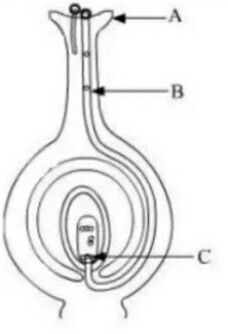
Question:80)Name the parts A, B and C shown in the diagram and write their functions.
 Apex Class
Leave a comment