
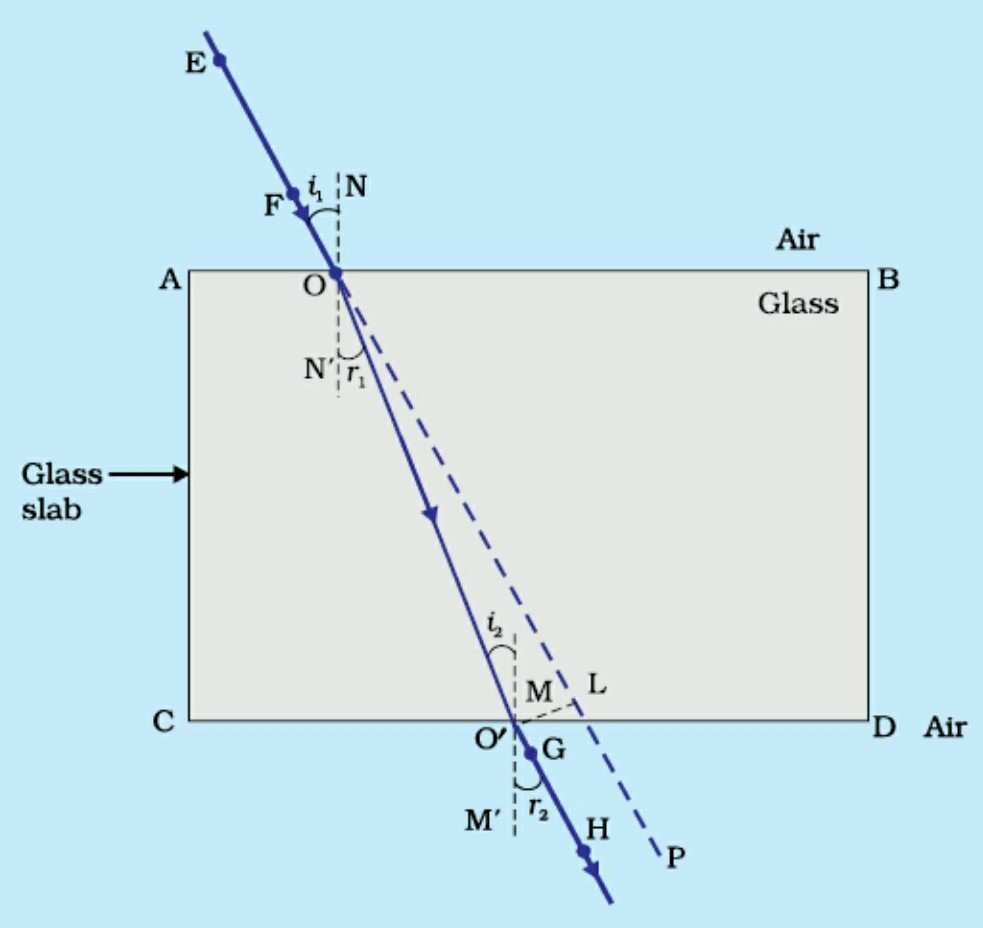
Question:1) “A ray of light incident on a rectangular glass slab immersed in any medium emerges parallel to itself.” Draw a labelled ray diagram to justify the statement.
Solution:
Question:2).An object of height 6 cm is placed perpendicular to the principal axis of concave lens of focal length 5 cm. Use lens formula to determine the position, size and nature of the image if the distance of the object from the lens is 10 cm.
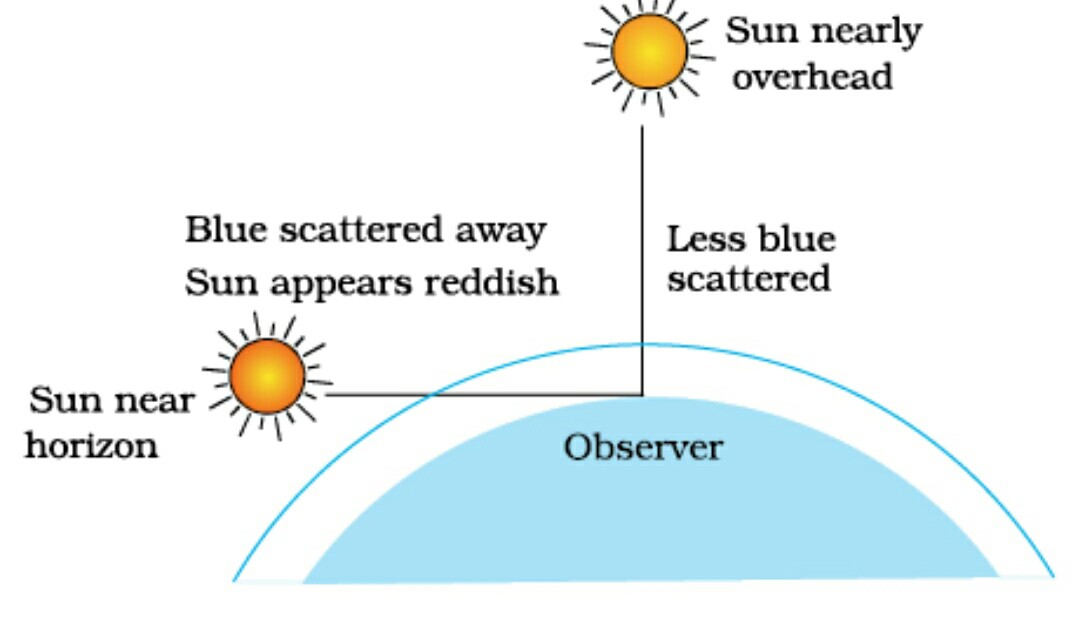
Question:3).State the difference in colour of the sun observed during sunrise/sunset and noon. Give explanation for each.
Solution:
Question:4).a)State the laws of reflection of light. Give one expression to relate the absolute refractive index of a medium with speed of light in vaccum.
b)The refractive indices of water and glass with respect to air are 4/3 and 3/2 respectively. If the speed of light in glass is 2×10^8 m/s. Find the speed of light in 1)Air and 2)Water.
Question:5).a)A person cannot read newspaper placed nearer than 50 cm from his eyes. Name the deffect of vision he is suffering from. Draw a ray diagram to illustrate this defect. List the possible two causes.
Draw a ray diagram to show how this defect may be corrected using a lens of appropriate focal length.
b)We see advertisement for eye donation on television or in newspaper. Write the importance of such advertisements.
Question:6).a)If the image formed by a lens is diminished in size and erect, for all position of the object, What type of lens is it.
b)Name the point on the lens through which a ray of light passes undeviated.
c)An object is placed perpendicular to the principal axis of a convex lens of focal lenth 20 cm. The distance of the object from the lens is 30 cm. Find
a)the position
b)the magnification
c)the nature of the image formed .
Question:7).(a)One half of the convex lens is covered with a black paper.Will such produce an image of the complete object at a distance of 80 cm from the lens.Support your answer with a ray diagram.
b)An object 5 cm high is held 25 cm away from a converging lens of focal length 10 cm.
1.Draw a ray diagram.
2.Calculate that position and size of the image formed.
3.What is the nature of the image?
Question:8).Two lens A and B have a power of +2D and -4D respectively. What is the nature and focal length of each lens ?
b)An object is placed at distance of 100 cm from each of the above lens A and B.
Calculate :
1.Image distance and
2.Magnification in each of the two cases.
Question:9).a)Describe the working of a human eye with the help of neat labeled diagram ?
b)How does the eye adjust itself to deal with light of a varying intensity ?
c)Why do you think the star seems higher than they actually are.
Solution:
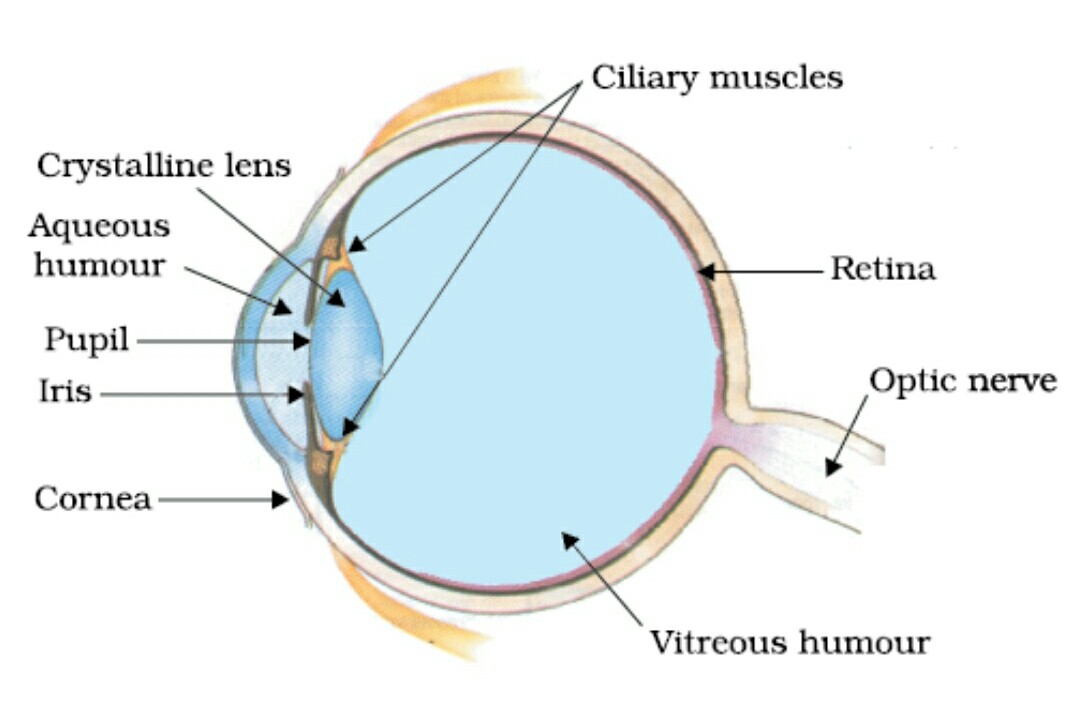
Question:10).(a)List the parts of the human eye that control the amount of light entering into it. Explain how they perform this function.
b)Write the function of retina in human eye ?
c)Do you know that the corneal implairment can be cured by replacing the defective cornea with the cornea of the donated eye ?
Question:11).a)Explain the following terms related to spherical lenses :
1.Optical centre
2.Centre of the curvature
3.Principal axis
4.Aperture
5.Principal focus
6.Focal lenght.
b)A converging lens has focal length of 12 cm. Calculate at what distance the object should be placed from the lens, So that it forms an image at 48 cm on the other side of lens.
Question:12).Write the importance of ciliary muscles in the human eye. Name the defect of vision that arises due to gradual weakening of the ciliary muscles.What type of lenses are required by the person suffering from this defect to see the object clearly ?
Question:13).What is mean by power of a lens? Define its SI unit.
You have two lenses A and B of focal length +10 cm and -10 cm,respectively.
State the nature and power of each lens.Which of the two lenses will form a virtual and magnified image of an object placed 8 cm from the lens? Draw a ray digram to justify your answer.
Question:14).It is desired to obtain an errect image of an object using concave mirror of focal length 12 cm.
a)What should be the range of distance of an object placed in front of the mirror?
b)Will the image be smaller or larger than the object be if it is placed 24 cm in front of the mirror? Draw a ray diagram for this situation to justify your answer.
Show the position of the pole, the principal focus and the centre of curvature in the above ray.
Question:15)What is the atmospheric refraction? Use this phenomenon to explain the following natural events :
a)Twinkling of stars.
b)Advanced sunshine and delayed sunset.
Draw the illustrate your answer.
Solution:
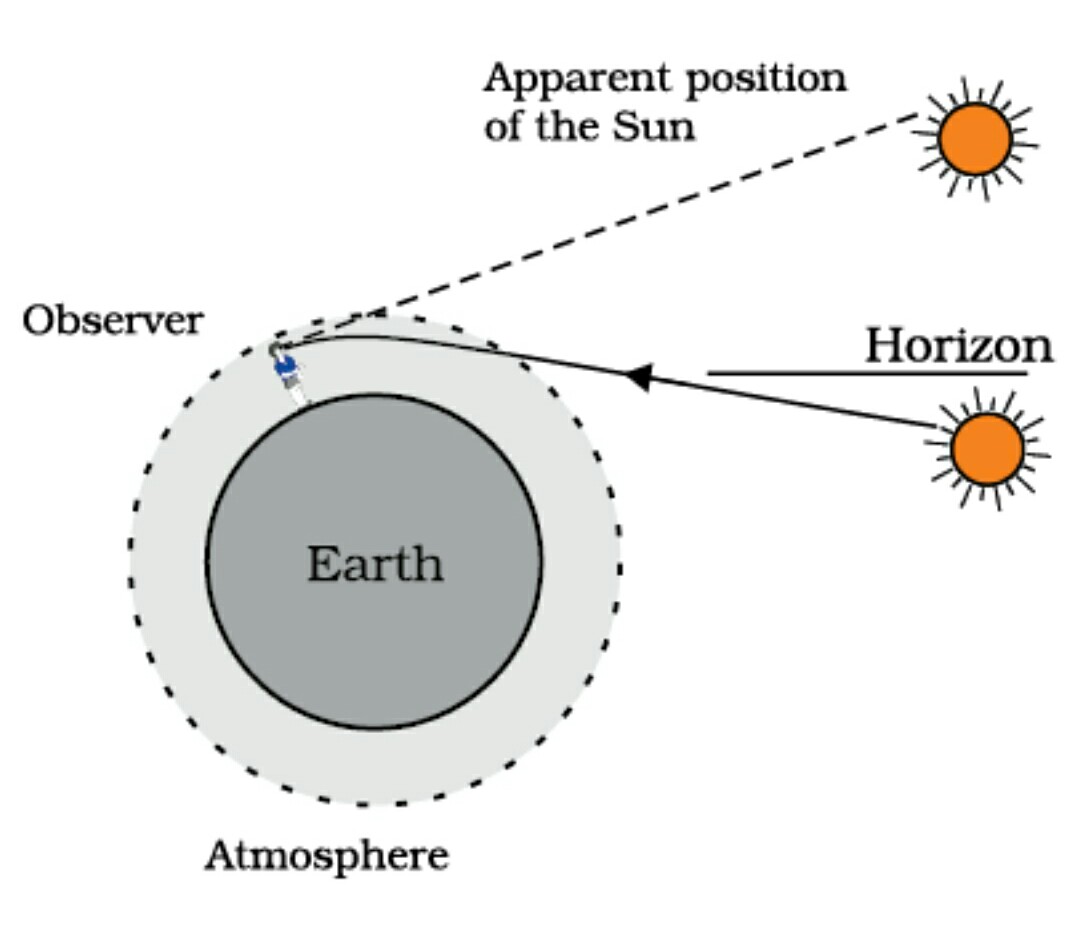
Apparent Position of Sun
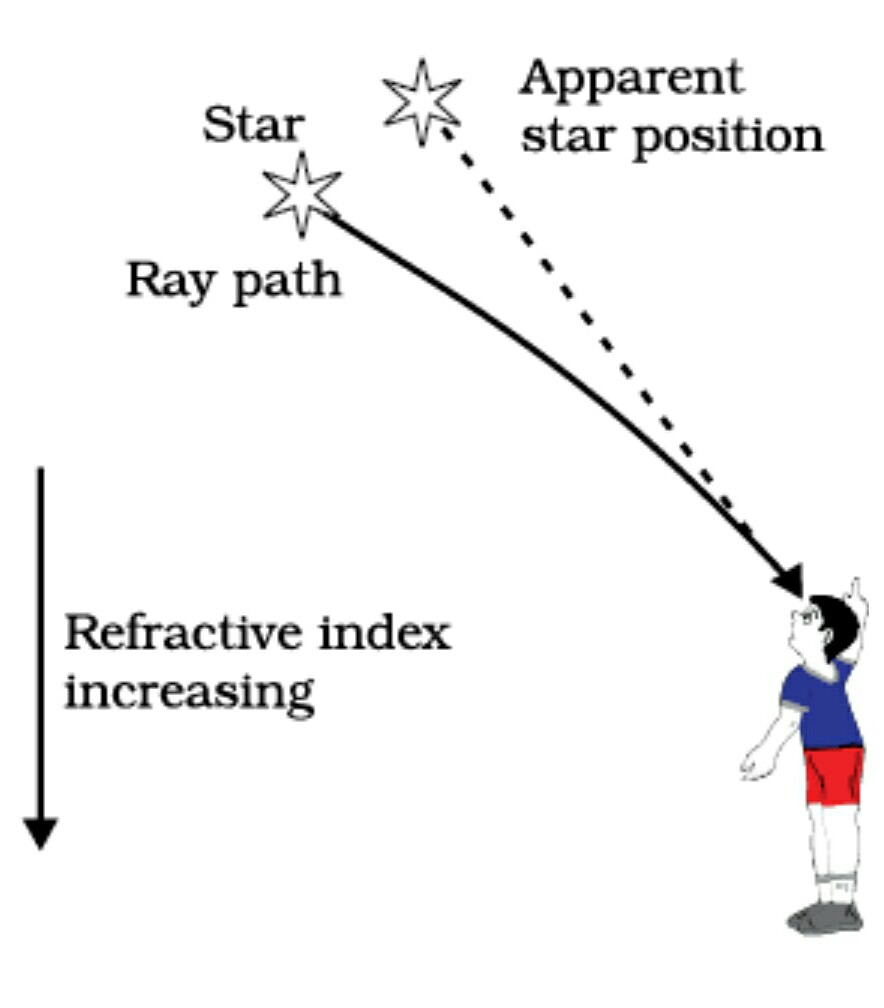
Apparent Position of Star
Question:16).A divergent lens of focal length 30 cm forms the image of an object of size 6 cm on the same side as the object at a distence of 15 cm from its optical centre.Use lens formula to determine the distance of the object from the lens and the size of the image formed.
b)Draw a ray diagram to show the formation of image in the above situation.
c)Define focal length of a divergent lens.
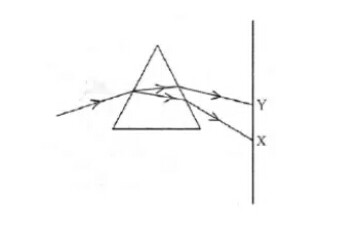
Question:17)In the figure given below a narrow beam of white light is shown to pass through a triangular glass prism.After passing through the prism it produces a spectrum XY on a screen.
a)State the colour seen at X and Y.
b)Why do different colours of white light bend through different angles with respect to the incident beam of light.
Question:18).What is solenoid? Draw a pattern of magnetic field lines of a solenoid through which a steady current flows. What does the pattern of field lines inside the solenoid indicate?
Question:19).A coil of insulated wire is connected to the galvanometer. What would be seen if a bar magnet with its north pole towards one face the coil is:
a)Moved quikly towards it.
b)Moved quickly away from the coil.
c)Placed near it on face ?
Question:20).Mention any four limitations in harnessing wind energy on a large scale.
Question:21)At what distance should an object be placed from a convex lens of focal length 18 cm to obtain an image at 24 cm it on the other side. What will be the magnification produced in this case ?
Question:22).Derive the expression for the heat produced due to a current ‘I’ flowing for the time interval ‘T’ through a resistor ‘R’ having a pottential difference ‘V’ across the ends. With which name is the relation known? How much will an instrument of 12 W produce in one minute if it is connected to a battery of 12 V ?
Question:23).Explain with the help of a labelled circuit diagram how you will find the resistance of a combination of 3 resistors,of resistance R1,R2 and R3 joined in a parallel. Also mention how you will connect the ammeter and voltmeter in the circuit when measuring the current in the circuit and the pottential difference across one of the three resistors of the combination.
Question:24)State the two laws of reflection of light.
Question:25).The stars appears higher from horizon than they actually are. Explain why it is so.
Question:26).Draw a ray diagram and also state positions, the relative size and nature of the image formed by a concave mirror when the object is placed at the centre of curvature of the mirror.
Question:27)(a)”The refractive index of diamond is 242.” What is the meaning of this statement.
(b)Name a liquid whose mass density less than of water,but it is optically denser then water.
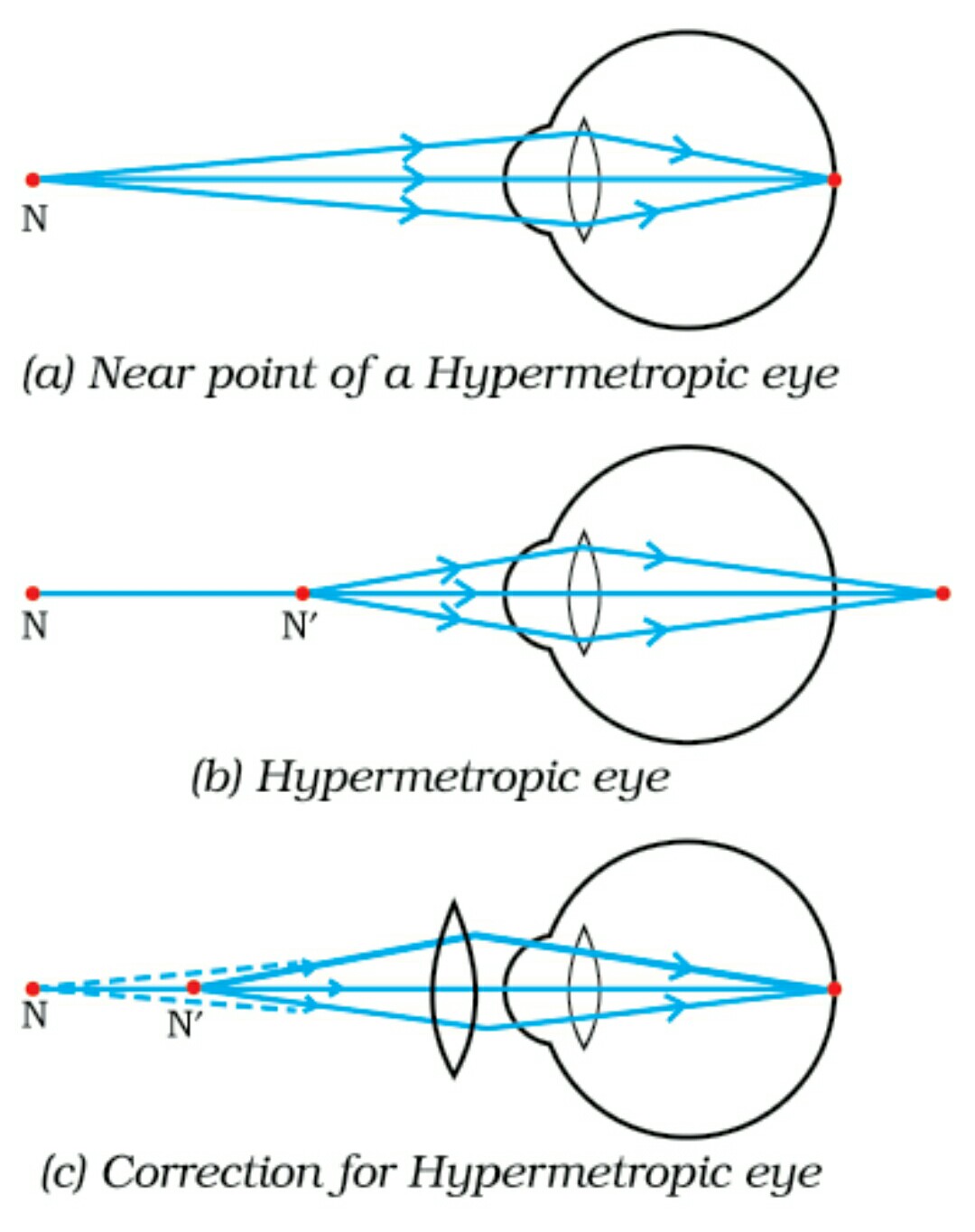
Question:28).What eye defect is hypermetropia? Describe with a ray diagram how this defect of vision can be corrected by using an appropriate lens.
Solution:
Question:29).A person ‘X’ is using bi focal lens whereas a person ‘Y’ is using concave horizontal lens for his left eye and a plane lens for his right eye. At the age of 60 ‘X’ is advised by a doctor to take a surgery due to some cloudy growth appearing over his right eye.
a)What kind of defect is ‘X’and’Y’ is suffering from? Explain.
b)Define accomodation of eye? What is least distance of distinct vision for ‘Y’ right eye ?
c)What could be the medical condition of ‘X’ at the age of 60?
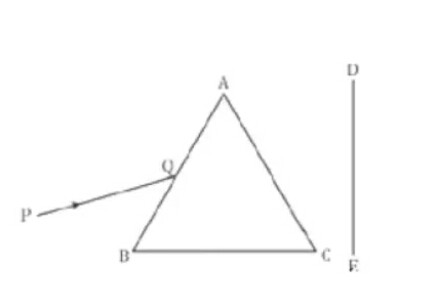
Question:30).A narrow beam PQ of light is passing through a glass prism ABC as shown in the diagram.
Trace it on your answer sheet and show the path of the emergent beam as observed on the screen DE.
a)Write the name and the cause of the phenomenon observed ?
b)Where else in nature is this phenomenon observed ?
c)Based on this observation, state the conclusion which can be drawn about the constituents of white light.
Question:31).With the help of scattering of light, explain the reason for the difference in colours of the sun as it appears during suset /sunrise and noon.
Question:32).An object of height 5 cm is perpendicular to the principal axis of a concave lens of focal length 10 cm. If the distance of the object from the optical centre of the lens is 20 cm, determine the position and the size of the image formed using the lens formula.
Question:33).Describe an actiity to show that the colours of white light splitted by a glass prism.Also draw a ray diagram to show the recombination of the spectrum of white light.
Question:34).Explain why a ray of light passing through the centre of curvature of concave mirror gets reflected along the same path.
Question:35).What is the nature of the image formed by a concave mirror gets reflected along the same path.
Question:36).What is the nature of the image formed by a concave mirror if the magnification produced by the mirror is +3 ?
Question:37).A charged particles enter at right angles in to uniform magnetic field shown below,What should be the nature of charge on particle if it begins its intraction with the magnetic field.
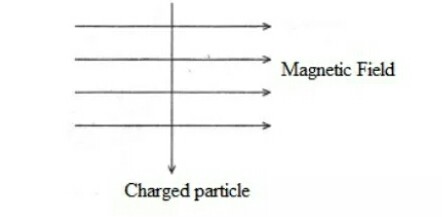
Question:38).Name the parts of our eyes that help us to focus near and distant object on quick succession.
Question:39).A convex lens of focal length 6 cm is held 4 cm from a newspaper, which has print 0.5 cm high. By calculation, determine the size and nature of the image produced ?
Question:40).”A concave mirror of focal length 15 cm can form a magnified, erect as well as inverted image of an object placed in from of it”. Justify this statement stating the position of the object with respect to the pole of the mirror in both the case for obtaining the images.
Question:41).Draw a ray diagram to show the path of the reflected ray corresponding to an incident ray of light parallel to the principal axis of a convex mirror and show the angle of incidence and angle of reflection on it.
Question:42).Consider a glass sphere silvered from outside having a radius ‘R’.Bisect a small piece from the sphere such that the inner surface acts as a mirror.
a)What would be the radius of curvature and focal length of the bisected piece.
b)Predict the nature and size of the image of a toy kept in front of the mirror; if the distance is R/3?
c)What will happen to the image : If the upper half of the mirror is covered with an opaque material.
Question:43).A person kept hostage in a cell covered by glass dome,some where under water. A cell is fully made of concrete with a huge hole in it. Sharks are swimming around the dome ready to eat, If the hostage tries to escape out.
a)Explain the path of light : Which would help the hostage to visualise the sharks with.
b)Are the angle of incidence and the angle of emergence same? Give reasons.
Question:44).A student wants to project the image of a candle flame on a screen 90 cm in front of mirror by keeping the flame at the distance of 15 cm from its pole.
a)Suggest the type of mirror he should use.
b)Determine the linear magnification in this case.
c)find the distance between the object and its image .
Draw a ray diagram to show the image formation in this case.
Question:45).Draw a ray diagram to show the path of the refracted ray in each of the following cases :
a)Passing through its optical centre.
b)parallel to its principal axis.
c)Directed towards its principal axis.
 Apex Class
Leave a comment