
Physics is the study of Nature and its surroundings.
What is Physical Quantity?
Physical quantity is a physical property of a material or system, that can be quantified by measurement.
The measurement of a physical quantity is mentioned in two parts.
A physical quantity can be expressed as a value, which is the algebraic multiplication of a numerical value and a unit.
Physical quantity is completely specified: If it has,
- Numerical Value (only ratio) – e.g. Refractive index dielectric constant.
- Magnitude only (Scalar) – e.g. mass, charge etc.
- Magnitude and Direction (Vector) – e.g. Displacement, torque etc.
Note: Physical quantity = Numerical value × unit
What are tensors?
Physical quantities which are not completely specified even by magnitude, unit and direction.
These physical quantities are called tensors.
EXAMPLE – MOMENT OF INERTIA.
Types of Physical quantities:
- Fundamental quantities
- Derived quantities.
Fundamental quantities : Physical quantities which do not depend upon any other quantity are defined as fundamental quantities.
Note: Fundamental quantities are also called as base quantities (SI Units).
SEVEN FUNDAMENTAL QUANTITIES IN SI SYSTEM:
- Mass (kg)
- Length (m)
- Time(s)
- Temperature (K)
- Electric Current (A)
- Luminous intensity (cd)
- Amount of substance (Mole)
Note: In 1971, a system of units were decided which are known as the International System of Units. It is abbreviated as SI from the French name Le System International d’ Unites.
What is unit?
The unit of a physical quantity is the reference standard used to measure it.
For the measurement of a physical quantity, a definite magnitude of quantity is taken as standard and the name given to this standard is called unit.
Important Definitions: SI Units
- Length(m) :- The distance traveled by light in vaccum in second is called 1 meter.
- Mass(kg) :- The mass of a cylinder made of platinum-iridium alloy kept at International Bureau of Weights and Measures is defined as 1 kilogram.
- Time(s) :- The second is the duration of 9,192,631,770 periods of the radiation corresponding to the transition between the two hyper-fine levels of the ground state of the cesium-133 atom.
- Electric current(A) :- If equal currents are maintained in the two infinitely long wires of negligible cross section, so that the force between them is (2/10000000) newton per meter of the wires, the current in any of the wires is called 1 Ampere.
- Thermodynamic Temperature(K) :- The fraction (2/273.16) of the thermodynamic temperature of triple point of water is called 1 Kelvin.
- Luminous Intensity :- 1 candela is the luminous intensity of black body of surface area (2/600000) m2 placed at the temperature of freezing platinum and at a pressure of 101,325 N/m2, in the direction perpendicular to its surface.
- Amount of substance :- The mole is the amount of a substance that contains as many elementary entities as there are number of atoms in 0.012 kg of carbon-12 (isotope of Carbon).
Supplementary Units :-
Radian :- 1 radian is the angle subtended by an arc of length equal to the radius, of the center of the circle.
Ste-radian :- It is defined as the solid angle subtended at the center of a sphere by an area of its surface equal to the square of radius of the sphere.
Other commonly used international system of units are:-
- CGS (centimeter, gram and seconds system)
- FPS (foot, pound and seconds system) – British system
- MKS (meter, kilogram, seconds system) – Metric system
SI Prefix :-
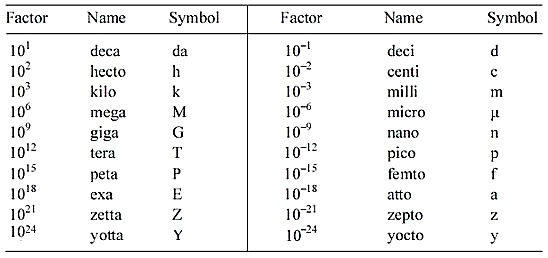
The magnitude of physical quantities vary over a wide range. So in order to express very large magnitude more compactly, “CGPM” recommended standard prefixes for certain power of 10.
 Apex Class
Leave a comment