
NCERT In Text Questions
Page No: 69
1. What is a tissue?
Answer
Tissue is a group of cells that are similar in structure and are organised together to perform a specific task.
2. What is the utility of tissues in multi-cellular organisms?
Answer
In multicellular organisms, the different types of tissues perform different functions. Since a particular group of cells carry out only a particular function, they do it very efficiently. So, multicellular organisms possess a definite division of labour.
Page No: 74
1. Name types of simple tissues.
Answer
Simple permanent tissues are of three types:→ Parenchyma
→ Collenchyma
→ Sclerenchyma
Parenchyma tissue is of further two types:
• Aerenchyma
• Chlorenchyma
2. Where is apical meristem found?
Answer
Apical meristem is present at the growing tips of stems and roots.
3. Which tissue makes up the husk of coconut?
Answer
Sclerenchyma tissue makes up the husk of coconut.
4. What are the constituents of phloem?
Answer
The constituents of phloem are:
→ Sieve tubes
→ Companion cells
→ Phloem parenchyma
→ Phloem fibres
Page No: 78
1. Name the tissue responsible for movement in our body.
► Muscular tissue
2. What does a neuron look like?
Answer
Neuron look like a star shaped cell with a tail.
3. Give three features of cardiac muscles.
Answer
Three features of cardiac muscles are:
→ Cardiac muscles are involuntary muscles that contract rapidly, but do not get fatigued.
→ The cells of cardiac muscles are cylindrical, branched, and uninucleate.
→ They control the contraction and relaxation of the heart.
4. What are the functions of areolar tissue?
Answer
Functions of areolar tissue:
→ It helps in supporting internal organs.
→ It helps in repairing the tissues of the skin and muscles.
Page No: 79
Excercise
1. Define the term “tissue”.
Answer
Tissue is a group of cells that are similar in structure and are organized together to perform a specific task.
2. How many types of elements together make up the xylem tissue? Name them.
Answer
Xylem is composed of following elements:
→ Tracheids
→ Vessels
→ Xylem parenchyma
→ Xylem fibres
3. How are simple tissues different from complex tissues in plants?
AnswerSimple tissueComplex tissueThese tissues consist of only one type of cells.These tissues are made up of more than one type of cells.The cells are more or less similar in structure and perform similar functions.Different types of cells perform different functions. For example, in the xylem tissue, tracheids help in water transport, whereas parenchyma stores food.Three types of simple tissues in plants are parenchyma, collenchyma, and sclerenchyma.Two types of complex permanent tissues in plants are xylem and phloem.
5. What are the functions of the stomata?
Answer
The functions of stomata are:
→ The exchange of gases (CO2 and O2) with the atmosphere.
→ The loss of excess water in the form of water vapour which is known as transpiration.
6. Diagrammatically show the difference between the three types of muscle fibres.
Answer
The three types of muscle fibres are: Striated muscles, smooth muscles (unstriated muscle fibre), and cardiac muscles.
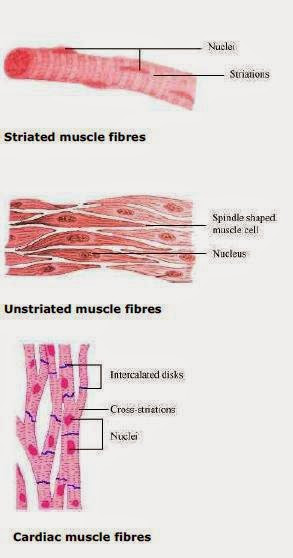
7. What is the specific function of the cardiac muscle?
Answer
The specific function of the cardiac muscle is to control the contraction and relaxation of the heart.
8. Differentiate between striated, unstriated and cardiac muscles on the basis of their structure and site/location in the body.
AnswerStriated muscleUnstriated muscleCardiac muscleOn the basis of structure:Cells are cylindricalCells are longCells are cylindricalCells are not branchedCells are not branchedCells are branchedCells are multinucleateCells are uninucleateCells are uninucleateAlternate light and dark bands are presentThere are no bands presentFaint bands are presentIts ends are bluntIts ends are taperingIts ends are flat and wavyOn the basis of location:These muscles are present in body parts such as hands, legs, tongue, etc.These muscles control the movement of food in the alimentary canal, the contraction and relaxation of blood vessels, etc.These muscles control the contraction and relaxation of the heart
9. Draw a labelled diagram of a neuron.
Answer

10. Name the following:
(a) Tissue that forms the inner lining of our mouth.
► Epithelial tissue
(b) Tissue that connects muscle to bone in humans.
► Tendon
(c) Tissue that transports food in plants.
► Phloem
(d) Tissue that stores fat in our body.
► Adipose tissue
(e) Connective tissue with a fluid matrix.
► Blood
(f) Tissue present in the brain.
► Nervous tissue
. Identify the type of tissue in the following: skin, bark of tree, bone, lining of kidney tubule, vascular bundle.
Answer
→ Skin: Stratified squamous epithelial tissue
→ Bark of tree: Simple permanent tissue
→ Bone: Connective tissue
→ Lining of kidney tubule: Cuboidal epithelial tissue
→ Vascular bundle: Complex permanent tissue
12. Name the regions in which parenchyma tissue is present.
Answer:Leaves, fruits, and flowers are the regions where the parenchyma tissue is present.
13. What is the role of epidermis in plants?
Answer:Epidermisis present on the outer surface of the entire plant body which perform following role:
→ It is a protective tissue of the plant body.
→ It protects the plant against mechanical injury.
→ It allows exchange of gases through the stomata.
14. How does the cork act as a protective tissue?
Answer:The outer protective layer or bark of a tree is known as the cork. It is made up of dead cells. Therefore, it protects the plant against mechanical injury, temperature extremes, etc. It also prevents the loss of water by evaporation.
15. Complete the table:

Answer

 Apex Class
Leave a comment