NUTRITION IN ANIMALS
• Animal nutrition includes nutrient requirement, mode of intake of food and its utilisation.
• The food components such as carbohydrates are complex substances.
• These cannot be utilised as such.
• So need to broken down into simpler substances.
• The breaking of complex substances into simpler substances is called digestion.
Different ways of taking food:
Taking food into the body varies in different organisms.
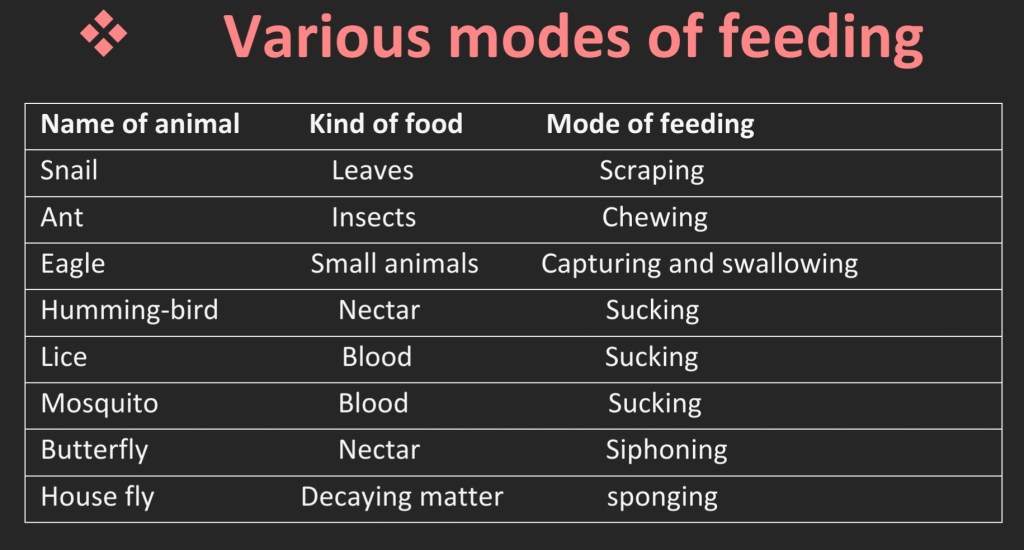
Bees and humming-birds suck the nectar of plants.
Infants of human and many other animals feed on mother’s milk.
Snakes(e.g. python) swallow the animals.
Some aquatic animals filter tiny food particles and feed upon them.
Various modes of feeding
Digestion in Humans
• We intake food through the mouth, digest and utilise it.
• The undigested parts of the food are excrete out.
Organs (parts) involved in digestive system:
• It begins at the buccal cavity and ends at the anus.
• The food passes through a continuous canal.
• The canal is divided into various compartments:
(1) buccal cavity, (2) foodpipe or oesophagus, (3)stomach, (4) small intestine, (5) large intestine
(6)ending in the rectum and (7) the anus.
• These parts together form the alimentary canal (digestive tract).
Process of digestive system:
• As food travels through the various compartments, the food components get digested gradually.
• The inner walls of the stomach, the small intestine, and the various glands(salivary glands, the liver, the pancreas)associated with the canal secrete digestive juices.
• These juices convert complex substances into simpler ones.
• The digestive tract and the associated glands together constitute the digestive system.
To know what happens to the food in different parts of the digestive tract:
The mouth and buccal cavity
• Food is taken through the mouth has the salivary glands which secrete saliva.
• The process of taking food into the body is called ingestion.
• We chew the food with the teeth and break it mechanically into small pieces.
• Each tooth is fixed iMilk teeth and permanent teeth
• The first set of teeth grows during infancy.
• The teeth fall off at the age between six to eight years named as milk teeth.
• The second set that take the position of milk teeth are the permanent teeth.
• They may last throughout life or fall off during old age or due to some dental disease.
Sweets and tooth decay
• Normally bacteria are in our mouth but not harmful
• But, if not clean the teeth and mouth after eating, harmful bacteria begin to live and grow.
• These bacteria break down the sugars and release acids.
• The acids gradually damage the teeth called tooth decay.
• If not treated in time, it causes severe toothache results in tooth loss.
• Chocolates, sweets, soft drinks and other sugar products are the major culprits of tooth decay.
• Therefore, one should clean the teeth with a brush at least twice a day and rinse the mouth after every meal.
n a separate socket in the gums.
• Our teeth vary in appearance and perform different functions naming as:
Milk teeth and permanent teeth
• The first set of teeth grows during infancy.
• The teeth fall off at the age between six to eight years named as milk teeth.
• The second set that take the position of milk teeth are the permanent teeth.
• They may last throughout life or fall off during old age or due to some dental disease.
Sweets and tooth decay
• Normally bacteria are in our mouth but not harmful
• But, if not clean the teeth and mouth after eating, harmful bacteria begin to live and grow.
• These bacteria break down the sugars and release acids.
• The acids gradually damage the teeth called tooth decay.
• If not treated in time, it causes severe toothache results in tooth loss.
• Chocolates, sweets, soft drinks and other sugar products are the major culprits of tooth decay.
• Therefore, one should clean the teeth with a brush at least twice a day and rinse the mouth after every meal.Eat in a hurry, talk or laugh while eating, may cough, get hiccups or a choking sensation.
• This occurs when food particles enter the windpipe carries air from the nostrils to the lungs runs adjacent to the foodpipe.
The foodpipe/oesophagus
• The swallowed food run through foodpipe or oesophagus.
• The foodpipe move along the neck and the chest.
• Food is pushed down by movement of the wall of the foodpipe takes place throughout the alimentary canal and pushes the food downwards.
The stomach
• It is a thick-walled bag shapes like a flattened J and widest part of the alimentary canal.
• Receives food from the food pipe at one end and opens into the small intestine at the other.
• Inner lining of the stomach secretes mucous (protects lining of stomach), hydrochloric acid and digestive juices.
• Acid kills many bacteria present in the food and makes the medium acidic.
• Digestive juices breaks the proteins into simpler substances.
The small intestine
• It is highly coiled about 7.5 metres long.
• Receives secretions from the liver and the pancreas.
• The liver is a reddish brown gland located in the upper part of the abdomen on the right side.
• It is the largest gland in the body secretes bile juice stored in a sac called the gall bladder.
• The bile plays vital role in the digestion of fats.
• The pancreas is a large cream coloured gland located just below the stomach.
• The pancreatic juice acts on carbohydrates, fats and proteins and converted into simpler forms.
• Part of Digested food reaches the lower part of the small intestine where the intestinal juice completes the digestion of all components of the food.
• The carbohydrates get broken into simple sugars such as glucose, fats into fatty acids and glycerol, and proteins into amino acids.
Absorption in the small intestine
• The process of digested food pass into the blood vessels in the wall of the intestine is called absorption.
• The inner walls of the small intestine have thousands of finger-like outgrowths. These are called villi (singular villus).
• The villi increase the surface area and surface of the villi absorbs the digested food.
• The transportation of absorbed digested food from blood vessels to different body organs in which they build complex substances like proteins is called assimilation.
• In the cells, glucose breaks using oxygen into carbon dioxide and water, energy is released.
• Remaining undigested and unabsorbed food goes into the large intestine.
Large intestine
• It is wider and shorter than small intestine about 1.5 metre in length.
• It absorb water and few salts from the undigested food.
• Remaining waste passes into the rectum, remains as semi-solid faeces(waste).
• The faecal matter is removed through the anus from Time-to-time is called egestion.
Digestion in Grass-eating Animals
• Cows, buffaloes and other grass-eating animals rapidly swallow the grass and store it in the stomach called rumen in which food gets partially digested called cud.
• The process in which cud come back to the mouth in small lumps and the animal chews it, is called rumination.
• These animals are called ruminants.
• The grass is rich in cellulose (type of carbohydrate).
• In ruminants like cattle, deer, etc., bacteria present in rumen helps in digestion of cellulose.
• Many animals, and humans, cannot digest cellulose.
• Animals like horses, rabbit, etc., have a large sac-like structure called Caecum between the oesophagus and the small intestine.
• The cellulose is digested by certain bacteria which are not present in humans.
Feeding and Digestion in Amoeba
Amoeba is a microscopic single-celled organism lived in pond water.
It has a cell membrane, a nucleus and many small bubble-like vacuoles in its cytoplasm.
It has finger-like projections, called pseudopodia.
Regularly changes its shape and position.
Feeds on some microscopic organisms.
The food get trapped in food vacuole.
Digestive juices are secreted in food vacuole.
Act on the food and break into simpler substances.
Gradually the digested food is absorbed and used for growth, maintenance and multiplication.
The undigested food is excreted outside by the vacuole.
 Apex Class
Leave a comment