
ELECTRICITY: It is a controllable and convenient form of energy for a variety of uses in homes, schools, hospitals, rail transport, industries and so on.
ELECTRIC CURRENT
Electric current is expressed by the amount of charge flowing through a particular area in unit time.
SYMBOL FOR ELECTRIC CURRENT => I
SYMBOL FOR ELECTRIC CHARGE => Q
SYMBOL FOR TIME => t
If a net charge ‘Q’, flows across any cross-section of a conductor in time ‘t’, then the current ‘I’, through the cross-section is
I = Q / t ——> Equation (1)
Or, Q = I × t —–> Equation (2)
Or, t = Q / I—–>Equation (3)
In other words, it is the rate of flow of electric charges.
The SI unit of electric charge is Coulomb (C).
which is equivalent to the charge contained in nearly 6 × 10^18 electrons.
We know that an electron possesses a negative charge of 1.6 × 10^(–19) C.
ELECTRIC CIRCUIT
A continuous and closed path of an electric current is called an electric circuit.
The electric current is expressed by a unit called ampere (A). Named after the French scientist, Andre-Marie Ampere (1775–1836).
One ampere is constituted by the flow of one coulomb of charge per second, that is, 1 A = 1 C/1 s.
Small quantities of current are expressed in
milli-ampere (1 mA = 10–3 A) or, micro-ampere (1 µA = 10–6 A).
An instrument called ammeter measures electric current in a circuit.
Ammeter connected in series in a circuit through which the current is to be measured.
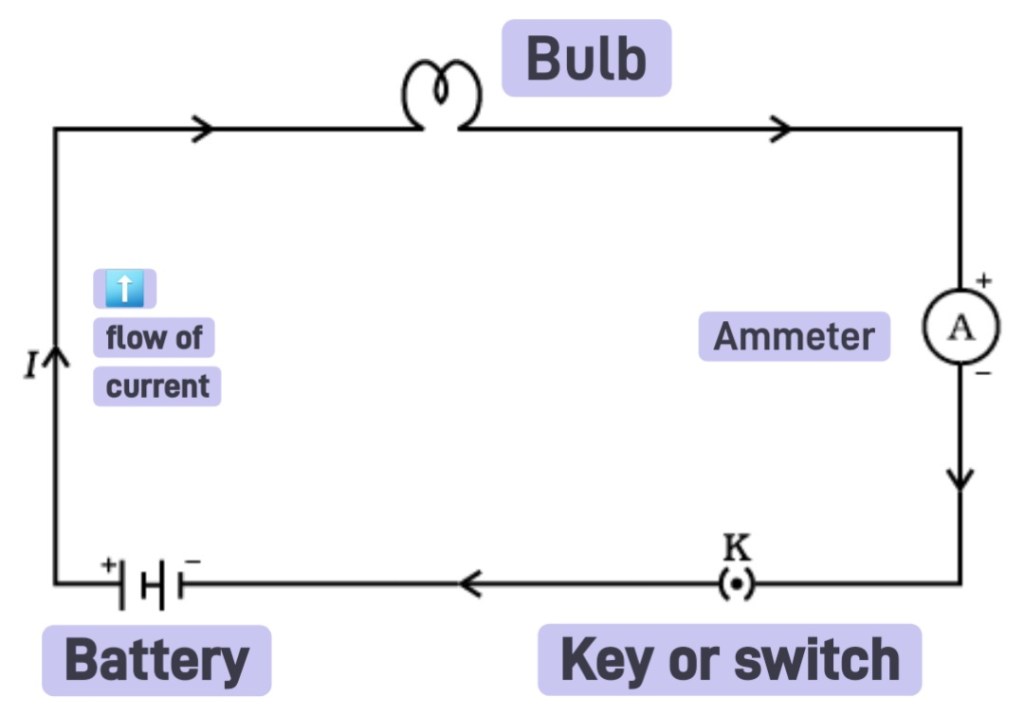
In circuits using metallic wires, electrons constitute the flow of charges.
In an electric circuit the direction of electric current is taken as opposite to the direction of the flow of electrons, which are negative charges.
NCERT Example 12.1
A current of 0.5 A is drawn by a filament of an electric bulb for 10 minutes. Find the amount of electric charge that flows through the circuit.
Solution
We are given,
Current (I) = 0.5 Ampere
Time (t) = 10 min => 10 × 60 sec => 600 s.
( 1 minute = 60 seconds )
From Equation(2) above , we have
Q = It
= 0.5 A × 600 s
= 300 C
 Apex Class
Leave a comment