Fibre to Fabric
• Fibres obtained from plants.
• Wool and silk fibres obtained from animals.
• Wool obtained from fleece (hair) of sheep or yak.
• Silk fibres come from cocoons of the silk moth.
Animal fibres — wool and silk
• Wool obtained from sheep, yak and some other animals.
• They carry hair on their body.
• Hair has a property to hold air(a poor conductor of heat).
• So, hair keeps these animals warm.
• The hairy skin of the sheep has two types of fibres that form its fleece:
(i) the coarse beard hair, and (ii) the fine soft under-hair close to the skin.
• The fine hair provide the fibres for making wool.
• This process of selecting parents for obtaining special characters in their offspring, such as soft under hair in sheep, is termed ‘selective breeding’.
Animals that yield wool
• Yak wool is common in Tibet and Ladakh.
• Mohair(very soft wool) that comes from a angora goats, found in hilly regions(Jammu and Kashmir).
• Wool is also obtained from goat hair.
• The under fur of Kashmiri goat is soft.
• It is woven into fine shawls called Pashmina shawls.
• The fur (hair) on the body of camels is also used as wool.
• Llama and Alpaca(South America) also yield wool
From fibres to wool : Sheep are reared to obtain wool.
Their hair is cut and processed into wool. The process is as follows:
Rearing and breeding of sheep:
• Sheep are herbivores and eat grass and leaves.
• Rearers also feed them on a mixture of pulses, corn, jowar, oil cakes (material left after taking out oil from seeds) and minerals.
• In winter, sheep are kept indoors and fed on leaves, grain and dry fodder.
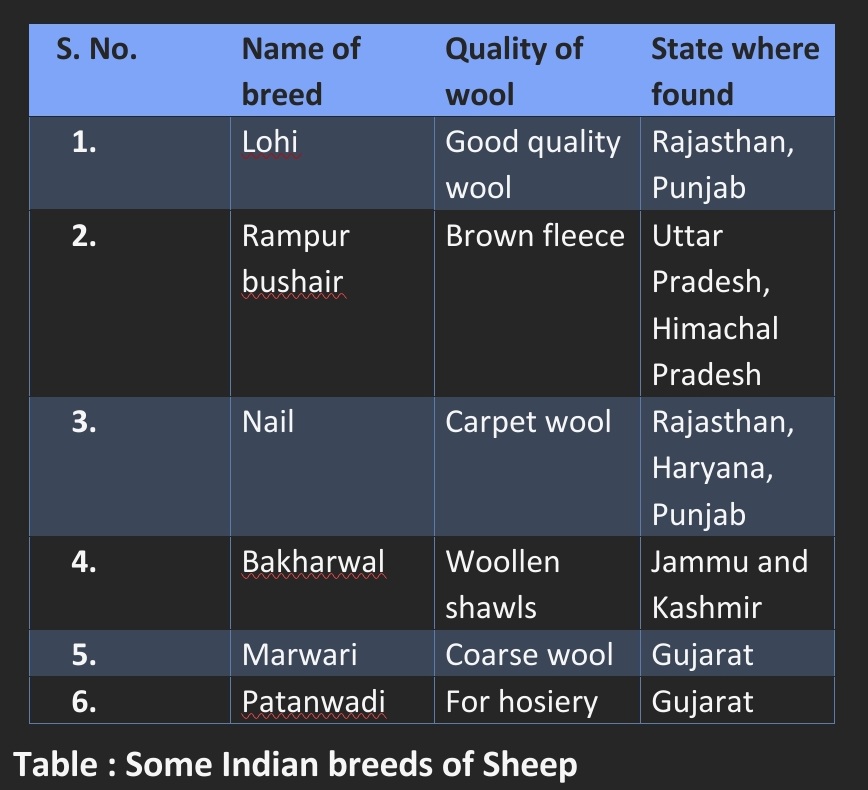
• Certain breeds of sheep have thick hair on their body which yields good quality wool in large quantities.
• Hence, these sheep are “selectively bred”.
• Once the reared sheep have developed a thick growth of hair, hair is shaved off for getting wool.
Processing fibres into wool
Step I:
• The fleece of the sheep along with a thin layer of skin is removed from its body. This process is called shearing.
• Machines are used to shave off hair.
• Usually, hair are removed during the hot weather.
• This enables sheep to survive without their protective coat of hair.
• The hair provide woollen fibres.
• Woollen fibres are then processed to obtain woollen yarn.
• Also, the hair of sheep grow again just as our hair does.
Step II:
• The sheared skin with hair is thoroughly washed to remove grease, dust and dirt. This is called scouring.
• Presently scouring is done by machines.
Step III:
• Later, sorting is done.
• The hairy skin is sent to a factory where hair of different textures are separated or sorted.
Step IV:
• The small fluffy fibres, called burrs, are collected from the hair.
• These burrs sometimes appear on your sweaters.
• The fibres are scoured again and dried. This is the wool ready to be drawn into fibres.
Step V:
• The fibres dyed in various colours, as like natural fleece of sheep and goats is black, brown or white.
Step VI:
• The fibres then straightened, combed and rolled into yarn.
• The longer fibres are made into wool for sweaters.
• The shorter fibres woven into woollen cloth.
The representation of processing of fibre into wool as follows:
Shearing → Scouring → Sorting → Cleaning of burrs→ Dyeing→ Rolling
Silk
• Silk fibres are also animal fibres.
• Silkworms spin the ‘silk fibres’.
• The rearing of silkworms for silk is called sericulture.
Life history of silk moth
• The female silk moth lays eggs, produce hatch larvae known as caterpillars or silkworms.
• They grow in size and when ready to enter the next stage of its life history called pupa, firstly weaves a net to hold itself.
• Then it swings its head from side to side in the shape of the eight (8) figure.
• During these movements of the head, the caterpillar secretes fibre made of a protein which hardens on exposure to air and becomes silk fibre.
• Soon the caterpillar completely covers itself by silk fibres and turns into pupa. This covering is known as cocoon.
• This development of the pupa into moth continues inside the cocoon.
• Silk fibres are used for weaving silk cloth.
• The silk yarn (thread) is obtained from the cocoon of the silk moth.
• Variety of silk moths which are different from one another.
• The silk yarn is different in texture (coarse, smooth, shiny, etc.).
• Thus, tassar silk, mooga silk, kosa silk, etc., are obtained from cocoons spun by different types of moths.
• The most common silk moth is the mulberry silk moth.
• And silk fibre of this moth is soft, lustrous and elastic dyed in beautiful colours.
• Sericulture(culture of silkworms) is a very old occupation in India produces plenty of silk.
• China leads the world in silk production.
• India ranks among the leading silk producing countries.
From cocoon to silk
Rearing silkworms:
• A female silk moth lays hundreds of eggs at a time that are stored carefully on strips of cloth or paper and sold to silkworm farmers.
• The farmers keep eggs under hygienic and suitable conditions (temperature and humidity).
• The eggs are warmed to a suitable temperature for the larvae to hatch from eggs.
• This is complete when mulberry trees bear a fresh crop of leaves.
• The larvae(caterpillars or silkworms), eat day-night and extremely increases size.
• They kept in clean bamboo trays with freshly chopped mulberry leaves.
• After 25 to 30 days, they stop eating and move to a tiny chamber of bamboo in the tray to spin cocoons.
• Small racks or twigs may be provided in the trays to which cocoons get attached.
• The caterpillar spins the cocoon inside which develops the silk moth.
Processing silk:
• A pile of cocoons is used for obtaining silk fibres.
• The cocoons are kept under the sun or boiled from which silk fibres separate out.
• The process of taking out threads from the cocoon for use as silk is called reeling the silk.
• Reeling is done in special machines [unwind the fibres(threads) of silk from the cocoon].
• Silk fibres are then spun into silk threads, which are woven by weavers into silk cloth.
 Apex Class
Leave a comment