
Heat
Hot and Cold:
• In our daily life, we see a number of objects.
• Among them Some are hot and some are cold.
• For example tea is hot and ice is cold.
• List of commonly use objects (hot and cold) as below in Table.
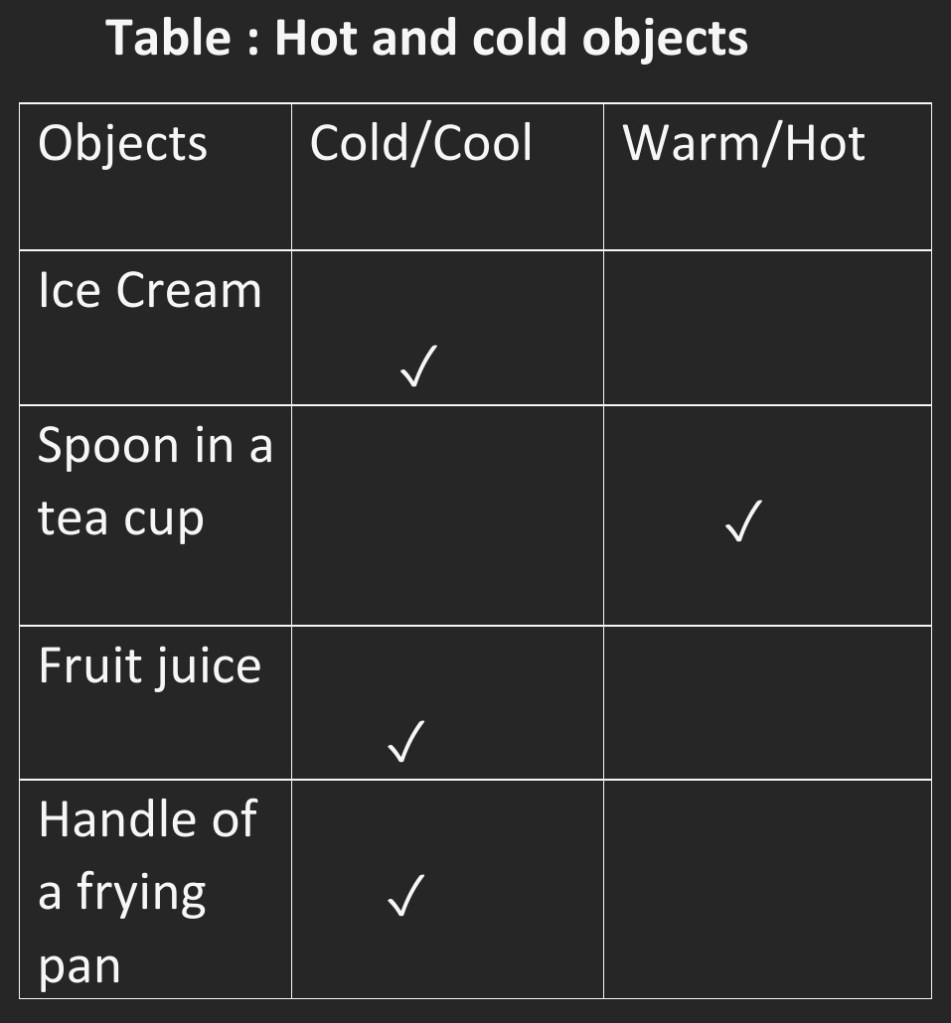
• A reliable measure of the hotness of an object is its temperature.
• Temperature is measured by a device called thermometer.
Measuring Temperature:
• When we had fever, the temperature was measured by a thermometer.
• The thermometer that measures our body temperature is called a clinical thermometer.
• A clinical thermometer has a long, narrow, uniform glass tube.
• It has a bulb(contains mercury) at one end.
• Outside the bulb, a small shining thread of mercury can be seen.
• Also, there is a scale on the thermometer.
• That scale is the celsius scale, denoted by °C(read as degree Celsius).
• A clinical thermometer reads temperature from 35°C to 42°C.
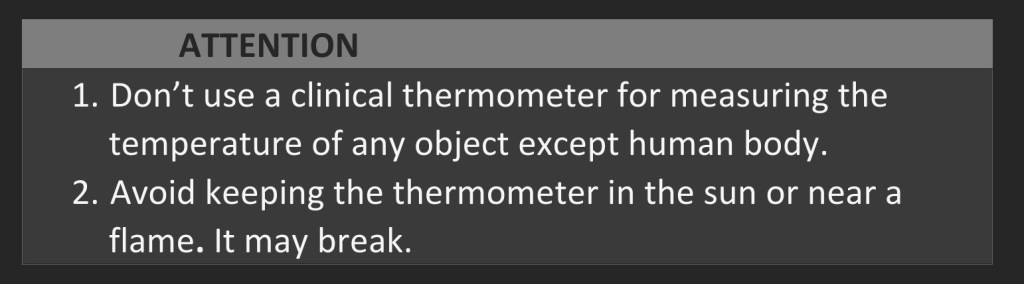
• It is designed to measure the temperature of human body only.
Reading a thermometer:
• First, note the temperature difference between the two bigger marks.
• Then, note down the number of divisions (shown by smaller marks) between these marks.
• The bigger marks read one degree and there are five divisions between them.
• Then, one small division can read 1/5= 0.2°C.
Precautions and Process for using a clinical thermometer:
• Thermometer should be washed(by antiseptic solution) before and after use.
• Before use, the mercury level is below 35°C.
• Read the thermometer keeping the level of mercury.
• Handle the thermometer with care. Do not hits against some hard object, it can break.
• Don’t hold the thermometer by the bulb while reading it.
• Wash the thermometer, preferably with an antiseptic solution.
• Hold it firmly and give it a few jerks. The jerks will bring the level of mercury down.
• Make sure that it falls below 35°C. Now place the bulb of the thermometer under your tongue.
• After one minute, take the thermometer out and note the reading.
• This is your body temperature.
Correct method of reading a clinical thermometer:
• The normal temperature of human body is 37°C.
• It is the average body temperature of a large number of healthy persons.
• It means temperature of every person may not be 37°C (slightly higher or slightly lower).
• The temperature of human body ranging between 35°C to 42°C.
• And hence, thermometer has the range 35°C to 42°C.
Laboratory Thermometer:
• To measure the temperature of other objects, there are other thermometers known as the laboratory thermometer.
• The range of a laboratory thermometer is generally from –10°C to 110°C.
• The maximum and minimum temperatures of the previous day, are measured by a thermometer called the maximum-minimum thermometer.
Transfer of Heat
• The process of transfer of heat from the hotter end to the colder end of an object is known as conduction.
• In solids, the heat is transferred by conduction.
• The materials which allow heat to pass through them easily are conductors of heat.
• Examples, aluminium, iron and copper.
• The materials which do not allow heat to pass through them easily are poor conductors of heat
• Examples, water, air, plastic and wood.
• Poor conductors are known as insulators.
• The process of transfer of heat through fluids (liquids and gases i.e. water and air) is known as convection.
• The air near the heat source gets hot and rises.
• Towards the top, the air gets heated by convection.
• Therefore, the hand above the flame feels hot.
• There is no convection on the sides. Hence, air does not feel as hot as at the top.
• During the day, the land gets heated faster than the water.
• Due to hot land, air over it becomes hotter and rises up.
• The warm air from the land moves towards the sea.
• The air from the sea is called the sea breeze.
• At night, the water cools down more slowly than the land.
• So, the cool air from the land moves towards the sea. This is called the land breeze.
• The process of arrival of heat to us from the sun known as radiation.
• Heat transfer by radiation does not require any medium.
• All hot bodies radiate heat.
• When this heat falls on some object, a part of it is reflected, a part is absorbed and a part may be transmitted.
• Due to absorption of heat by the objects the temperature of the object increases.
Kinds of clothes we wear in summer and winter:
• In summer we wear light-coloured clothes.
• Light coloured clothes reflect most of the heat that falls on them.
• Therefore, we feel more comfortable wearing them in the summer.
• In winter we usually wear dark-coloured clothes.
• Dark colour absorb more heat.
• Therefore, we feel comfortable with dark coloured clothes in the winter.
• Woollen clothes keep us warm in winter.
• Wool is a poor conductor of heat.
• Air trapped in between the wool fibres which prevents the flow of heat from our body to the cold surroundings.
• Hence, we feel warm.
 Apex Class
Leave a comment