
1) Fill in the blanks:
(a) The main step of nutrition in humans are Ingestion, digestion, absorption, assimilation and egestion.
(b) The largest gland in the human body is liver.
(c) The stomach release hydrochloric acid and digestive juices which act on food.
(d) The inner wall of the small intestine has many finger like outgrowths called villi.
(e) Amoeba digests it’s food in the food vacuole.
2) Mark ‘T’ if the statement is ‘True’ and ‘F’ if the statement is ‘False’.
(f) Digestion of starch starts in the stomach.(T/F)
Ans: F
(g) The tongue helps in making food with saliva.(T/F)
Ans: T
(h) The gall bladder temporarily stores bile. (T/F)
Ans: T
(i) The ruminants bring back swallowed grass into their mouth and chew it for some time. (T/F)
Ans: T
3) Tick mark the correct answer in each of the following:
a. Fat is completely digested in the
(i) stomach (ii) mouth (iii) small intestine (iv) large intestine.
Ans: iii) small intestine.
b. Water from the undigested food is absorbed mainly in the
(i) stomach (ii) foodpipe (iii) small intestine (iv) large intestine.
Ans: iv) large intestine.
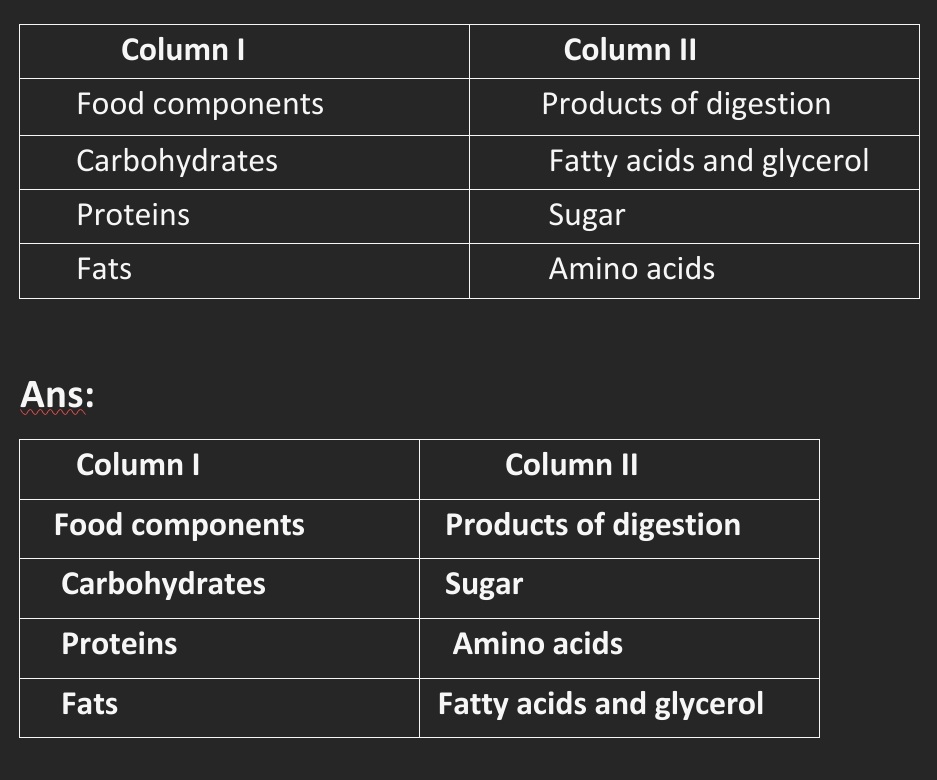
4) Match the items of column I with those given in column II:
5) What are villi? What is their location and functions?
Ans: i) Villi are the finger like outgrowths in inner walls of the small intestine.
ii) The location of the villi are in the wall of the small intestine.
iii) The function of the villi is : the villi increase the surface area for absorption of the digested food and that surface of the villi helps to absorb the digested food.
6) Where is the bile produced? Which component of the food does it help to digest?
Ans: The bile produced in the liver and the bile juice stored in the gall bladder. The bile helps in the absorption of fats.
7) Name the type of carbohydrate that can be digested by ruminants but not by humans. Give the reason also.
Ans: Carbohydrate that can be digested by ruminants but not by humans is cellulose. The cellulose is digested by certain bacteria which are not present in humans. Therefore, many animals, and humans, cannot digest cellulose.
8) Why do we get instant energy from glucose?
Ans: Glucose is a simple sugar which is easily breaks down by using oxygen and provides instant energy to the organism. It does not require digestion, it is directly absorbed into the blood. Hence, when we take glucose directly, it does not get digested. Therefore, glucose acts as an instant source of enerenerg
9) Which part of the digestive canal is involved in:
Ans:(i) Absorption of food- small intestine.
(ii) Chewing of food- buccal cavity.
(iii) Killing of bacteria- stomach.
(iv) Complete digestion of food- small intestine.
(v) Formation of faeces- large intestine.
10) Write one similarity and one difference between the nutrition in amoeba and human beings.
Ans: Similarity:
(i) In human, the digestive juices are secreted in the stomach and small intestine and in Amoeba, the digestive juices are secreted into food vacuole.
(ii) The food components taken by amoeba and human beings are complex substances.
(iii) The digestive juices convert complex substances into simpler (absorbable) substances.
Difference:
(i) Amoeba captures the food with the help of pseudopodia and engulfs it. In human beings, food is taken by the mouth.
(ii) In Amoeba, the undigested food is expelled outside by the vacuole. In human, the undigested food is removed through the anus.
13) Can we survive only on raw, leafy vegetables/ grass? Discuss.
Ans: The grass/ leafy vegetables are rich in cellulose, a type of carbohydrate. The cellulose is digested by bacteria which are absent in humans. That means cellulose cannot be digested by humans including many animals. Hence, we can not survive only on raw, leafy vegetables or grass.
 Apex Class
Leave a comment