
Weather :
- The daily weather report shows information about the temperature, humidity and rainfall during the past 24 hours.
- Also predicts the weather for the day.
- Humidity is a measure of the moisture in air.
- The weather reports are prepared by the Meteorological Department of the Government.
- They collects data on temperature, wind, etc., and makes the weather prediction.
Weather report of a week includes :
- Max. temp. (°C)
- Min. temp. (°C)
- Min. humidity (%)
- Max. humidity(%)
- Rainfall*(mm)
Rainfall may not be recorded for all the days since it may not rain everyday.
- Rainfall is measured by an instrument called the rain gauge.
- It is basically a measuring cylinder with a funnel on top to collect rainwater.
- The maximum and minimum temperatures recorded may be the same for some of the days.
- All the parameters are not the same on any two days.
- The day-to-day condition of the atmosphere at a place with respect to the temperature, humidity, rainfall, wind-speed, etc., is called the weather at that place.
- The temperature, humidity, and other factors are called the elements of the weather.
- Maximum and minimum temperature measured by special thermometers called maximum and minimum thermometers.
- The maximum temperature occurs generally in the afternoon.
- While the minimum temperature occurs generally in the early morning.
Responsible factors to change the weather :
- The sun is the primary source of energy that causes changes in the weather.
- The sun is a huge sphere of hot gases at a very high temperature.
- The energy emitted by the sun is so huge that it is the source of all heat and light on the earth.
- Energy absorbed and reflected by the earth’s surface, oceans and the atmosphere play important roles in determining the weather at any place.
- Near the sea, the weather is different from that of a place in a desert, or near a mountain.
Climate :
- The average weather pattern taken over a long time, say 25 years, is called the climate of the place.
- If the temperature at a place is high most of the time, then the climate of that place is hot.
- And if in the same place there is heavy rainfall on most of the days, then the climate of that place is hot and wet.
In Tables, we have given the climatic condition at two places in India: Srinagar in Jammu and Kashmir, and Thiruvananthapuram in Kerala.
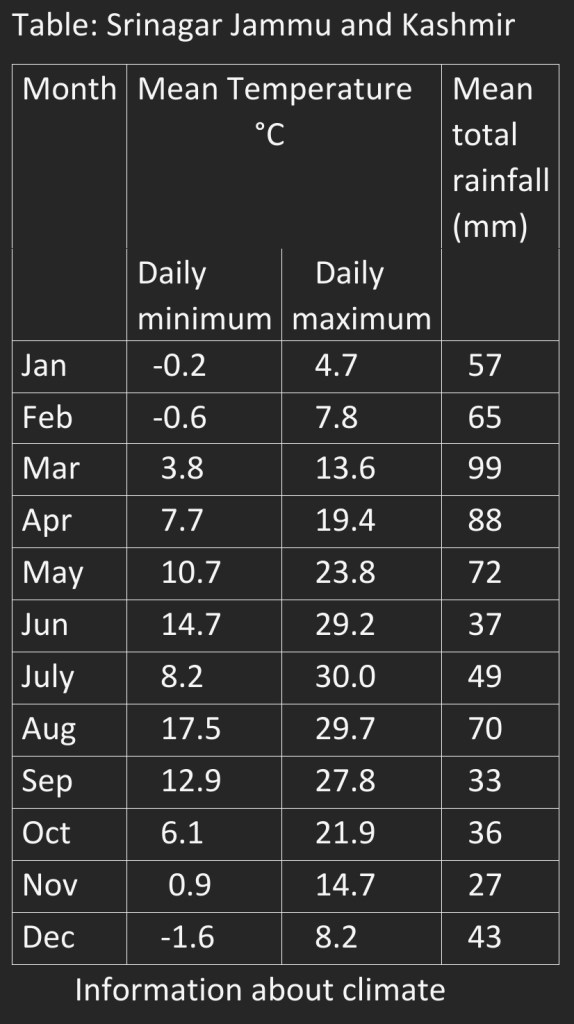
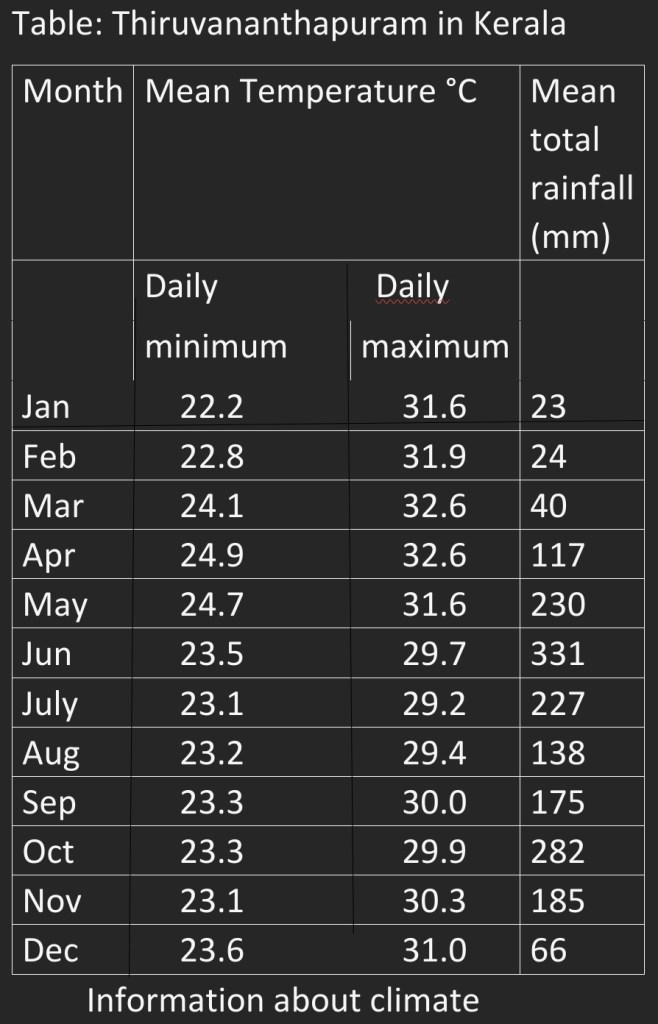
We can see in the table, Kerala is very hot and wet than Jammu & Kashmir, which has a moderately hot and wet climate for a part of the year.
• Also Rajasthan, has the high temperature during most part of the year.
• But during winter(lasts only for a few months) the temperature is quite low.
• Rajasthan receives very little rainfall. Hence, it is hot and dry
• The north-eastern India receives rain for a major part of the year.
• Therefore, the climate of the north-east is wet.
Climate and Adaptation :
• Climate has a profound effect on all living organisms.
• Animals living in very cold and hot climate must possess special features to protect themselves against the extreme cold or heat.
(i) The polar regions :
• The polar regions are situated near the poles, i.e., north pole and south pole.
• The polar regions present an extreme climate.
• These are covered with snow and very cold for most part of the year.
• For six months the sun does not set at the poles.
• And for the other six months the sun does not rise.
• In winters, the temperature can be as low as –37°C.
• Animals adapted to these severe conditions are polar bears and penguins.
Polar bears :
• Polar bears have white fur so, not easily visible in the snowy white background.
• It protects from their predators and helps in catching their prey.
• They have two thick layers of fur to protect them from extreme cold.
• Also have a layer of fat under their skin.
• So well-insulated to move slowly and to avoid getting overheated.
• Physical activities during warm days necessitate cooling. So, it is a good swimmer.
• It has wide and large paws which help to swim well and to walk with ease in the snow.
• While swimming, it can close its nostrils and can remain under water for long durations.
• It has a strong sense of smell so, it can catch its prey.
Penguin :
• It is white and merges with the white background.
• It has a thick skin and a lot of fat to protect it from cold.
• Like polar bears, penguins are also good swimmers.
• Their streamlined bodies and webs of feet, making them good swimmers.
Other animals living in polar regions:
• Many types of fishes, musk oxen, reindeers, foxes, seals, whales, and birds.
• Fish can remain under cold water for long.
• Birds must remain warm to survive.
• When winter comes, they migrate to warmer regions and come back after end of the winter.
• India is one of the destinations of many of these birds.
Well-known countries belongs to the polar regions :
Canada, Greenland, Iceland, Norway, Sweden, Finland, Alaska in U.S.A. and Siberian region of Russia.
(ii) The tropical rainforests :
• It has generally a hot climate because of its location around the equator.
• Even in the coldest month, the temperature is generally higher than about 15°C.
• During hot summers, the temperature may cross 40°C.
• Days and nights are almost equal in length throughout the year.
• These regions get plenty of rainfall.
• An important feature of this region is the tropical rainforests.
• Tropical rainforests are found in Western Ghats and Assam in India, Southeast Asia, Central America and Central Africa.
• Because of continuous warmth and rain, this region supports wide variety of plants and animals.
• The major types of animals living in the rainforests are monkeys, apes, gorillas, tigers, elephants, leopards, lizards, snakes, birds and insects.
Adaptations of these animals to a hot, humid climate:
• Many animals are adapted to living on the trees.
• Red-eyed frog has developed sticky pads on its feet to climb trees.
• To help them live on the trees, monkeys have long tails for grasping branches.
• Their hands and feet can easily hold on to the branches.
Food adopted by some animals:
Example: Bird Toucan possesses a long, large beak which helps to reach the fruits on branches.
Other tropical animals:
• Many animals have sensitive hearing, sharp eyesight and thick skin.
• A skin colour which helps them to camouflage by blending with the surroundings.
• This is to protect them from predators. For example, big cats (lions and tigers) have thick skins and sensitive hearing.
Lion-tailed Macaque (also called Beard ape) :
• The lion-tailed macaque (also called Beard ape) lives in the rainforests of Western Ghats.
• Its most outstanding feature is the silver-white mane, which surrounds the head from the cheeks down to its chin.
• A good climber and spends a major part of its life on the tree.
• Feeds mainly on fruits, seeds., young leaves, stems, flowers and buds.
• This beard ape searches for insects the bark of the trees.
• Since it is able to get sufficient food on the trees, it rarely comes down on the ground.
Elephant :
• Another well-known animal of Indian tropical rainforest is the elephant.
• It has adapted to the conditions of rainforests in many remarkable ways.
• It’s trunk uses it as a nose due to strong sense of smell. Also used for picking up food.
• Moreover, its tusks are modified teeth that tear the bark of trees (it loves to eat)
• It’s large ears help to hear very soft sounds.
• They also help the elephant to keep cool in the hot and humid climate of the rainforest.
Some countries where the tropical rainforests found :
India, Malaysia, Indonesia, Brazil, Republic of Congo, Kenya, Uganda, and Nigeria.
 Apex Class
Leave a comment