
Exercise
1) Why do organisms take food?
Ans – Food enable living organisms to grow, to build their bodies and provide energy to carry out life processes. The food contain Carbohydrates, fats, proteins, vitamins and minerals provide energy which is essential for growth and development. Therefore organisms take food.
2) Distinguish between a parasite and a saprotrope.
Ans:
3) How would you test the presence of starch in leaves?
Ans- With the help of Iodine test, we can test the presence of starch in leaves as follows:
I) By removing chlorophyll from the leaf by boiling it in alcohol and adding two drops of iodine solution.
II) The colour of leaf get change from green to blue indicates the presence of starch.
4) Give a brief description of the process of synthesis of food in green plants.
Ans- i) The leaves are the food factories of plants.
ii) water and minerals are present in the soil are absorbed by the roots and transported to the leaves by the vessels.
iii) The vessels run like pipe throughout the roots, the steam, the branches and the leaves and they form a continuous path for the nutrients to reach the leaf.
iv) From air, carbon dioxide is taken in through the pores present on the surface of leaves.
v) The leaves have a green pigment called chlorophyll which helps leaves to absorb the energy of the sunlight.
vi) In this way, the process of preparation of food in green plants from carbon dioxide and water occurs in the presence of sunlight and the process is called Photosynthesis.
6) Fill in the blanks:
i. Green plants are called Autotrophs since they synthesise their own food.
ii. The food synthesise by plants is stored as starch.
iii. In photosynthesis solar energy is absorbed by the pigment called chlorophyll.
iv. During photosynthesis plants take in carbon dioxide and release oxygen gas.
7) Name the following:
i) parasitic plant with yellow, slender and branched stem.
Ans – Cuscuta (Amarbel).
ii) A plant that is partially autotrophic.
Ans- Pitcher plant.
iii) The process through with leaves changes gaseous.
Ans- Stomata.
8) Tick the correct answer:
i. Cuscuta i)Autotroph ii) parasite iii) saprotroph iv) host
Ans- ii) parasite
ii. The plant which traps and feeds on insect is:
i)cuscuta ii) china rose iii) pitcher plant iv) rose
Ans- iii) pitcher plant
9) Match the items given in column I with choose in column II
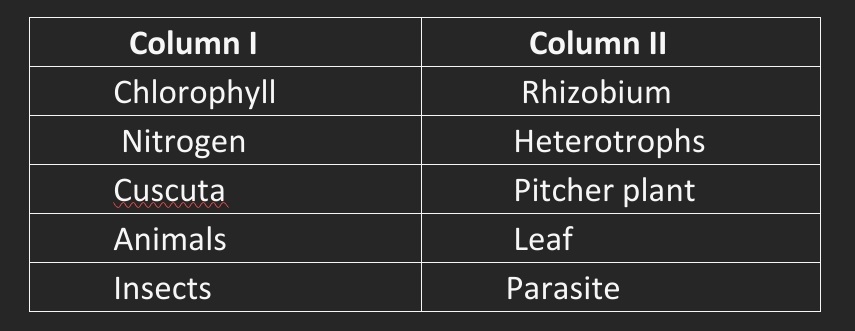
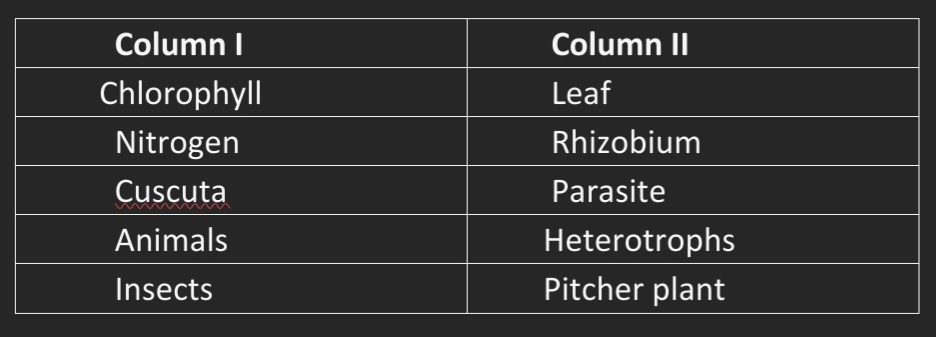
10) Mark ‘T’ if the statement is ‘True’ and ‘F’ if the statement is ‘False’.
i. Carbon dioxide is release during photosynthesis.(T/F)
Ans- F
ii. Plants which synthesise their food are called saprotrophs.(T/F)
Ans- F
iii. A product of photosynthesis is not a protein.(T/F)
Ans: T
iv. Solar energy is converted into chemical energy during photosynthesis.(T/F)
Ans: T
11) Choose the correct option from following:
Which part of the plant takes in carbon dioxide from the air for photosynthesis?
(i)Root hair (ii) Stomata (iii) Leaf veins (iv) petals
Ans: (ii) Stomata
12) Choose the correct option from following:
Plants take carbon dioxide from the atmosphere mainly through their:
(i)Roots (ii) stem (iii) flowers (iv) leaves
Ans: (iv) leaves
13) Why do farmers grow many fruits and vegetable crops inside large green houses? What are the advantages to the farmers?
Ans- Green houses provide favourable conditions for fruits and vegetable crops. That means it provide suitable temperature to crops for their growth.
Advantages to the farmers are:
i) Green houses protects crops from diseases.
ii) Green houses protects crops from wind, unfavorable climatic conditions, birds, animals and rodents(rat, squirrel etc).
iii) Farmers have bountiful crops.
 Apex Class
Leave a comment