
Question: 1)The atomic no. Of chlorine is 17. Give its number of valence electrons and valency.
Solution:
Atomic No. Of Chlorine = 17
Electronic Configuration = 2, 8, 7
Now,
Valence Electrons = No. Of electrons present in outermost shell, orbit or energy level.
Therefore,
Valence electrons of chlorine = 7
Valency of Chlorine = (8-7) = 1
Question: 2) What is meant by the term biosphere?
Solution:The biosphere is the layer of planet Earth where life exists.
All organisms, from the tiniest bacteria to the largest blue whale, need a place to live. The place on Earth’s surface where life dwells is called the biosphere.
Question: 3) When do we say that one joule work has been done by a force on an object?
Solution:When 1 Newton force is applied on an object and it is displaced by 1 metre then we can say that one joule of work is done.
Question: 4) List in tabular form any two distinguishing features between the animals belonging to the aves group and mammalian group.
Solution:
Two Features of Aves group:
1) Most birds (Aves) have feathers and they possess a beak.
2) They lay eggs. Hence they are oviparous.
Two features of Mammalian group:
1) They do not have feathers and the beak is also absent.
2) Some of them lay eggs and some give birth to young ones. Hence they are both oviparous and viviparous.
Question: 5) The symbol of an element is 24X12.
i) Write its Atomic no.
ii) Calculate the no. of neutrons.
Solution:
Since,
Symbol , Atomic no. and Atomic Mass no. is given in the ques.
Therefore,
1)Atomic no.of given element = 12
Atomic Mass no. of given element = 24
2) As we know that,
Atomic Mass No. = ( No. Of Protons + No. Of Neutrons)
Therefore,
No. Of Neutrons = ( Atomic Mass No. – No. Of Protons)
No. Of neutrons = (24-12) = 12
Question: 6) State the difference between density and relative density. Relative density of gold is 19.3 .If the mass of one cubic meter of water is 1000 kg, find the density of gold in SI units.
Solution: Density-Mass per unit volume of a substance is called density.
Relative density- The ratio b/w density of a substance and density of water is called relative density.
Now, It is given that,
Density of Gold (Au) = 19.3
Mass of water = 1000 kg
Volume of water = 1 m^3
Now, we know that,
Density of water = (Mass of water)/(Volume of water)
= 1000 kg/ 1 cubic.meter
= 1000 kg/m^3
Relative density of Gold =( Density of Gold)/ (Density of water)
19.3 = (Density of Gold)/(1000 kgm^-3).
Therefore,
Density of gold = 19.3 × 1000 kgm^-3
= 19300 kgm^3
Question: 7) State the meaning of 1 Pascal. A boy of mass 40 kg is standing on loose sand. If the area of his feet is 0.04 square meter. Calculate the pressure exerted by the boy on the sand. (g- 10m/s^2)
Solution: Force per unit area is known as pressure. Pascal is the SI unit of Pressure
Pressure = Force/area
1 pascal = 1 N/ 1 sq.m
When 1 N of force is applied on 1 sq. metre of an object , then it means that 1 pascal of pressure is applied on that object.
Numerical
Given,
Mass of a boy = 40kg
Area of boy’s feet = 0.04 sq. M
g = 10 m/s^2
Now , we know that,
F = mg = 40 × 10 = 400 N
Now,
Pressure = Force / area
= 400N/0.04 sq.m. = 10000 Pa
Question: 8) i)Convert into mole.
a) 36 g of H2O molecules.
b) 22 g of CO2 molecules.
ii) Name the elements present in Hydrogen bromide.
Solution: (a)As we know that
No. Of moles = Given Mass/Molar mass
n = m/M
1) Given mass of H2O = 36 gm
Molar mass of H2O = 18 gm
Therefore,
n = m/M
n = 36 gm/ 18 gm
n = 2
2) Given mass of CO2 = 22 gm
Molar mass of CO2 = 44 gm
Therefore,
n = m/M
n = 44 gm/ 22 gm
n = 2
(b) Hydrogen and Bromine are the elements which are present in Hydrogen bromide.
Question: 9) What are isotopes? Write two applications of isotope.
Solution: An isotope is a form of chemical element who have same atomic number but different mass no.
For example: 6C12 , 6C14.
Two Applications of Isotopes:
1) Uranium isotope ,Used as a nuclear fuel.
2) Cobalt isotope , used in a treatment of cancer.
3) Iodine isotope, used in a treatment of goitre.
Question: 10) List any two differences between Bryophytes and Pteridophytes. Give one example of each.
Solution:
Bryophytes:
1) True roots and leaves are absent.
2) Vascular tissue is absent.
Examples : hornworts , liveworts, mosses
Pteridophytes:
1) True roots and leaves are present.
2) Vascular tissue is present.
Examples: ferns, horsetails, clubmosses, spikemosses and quillworts.
Question: 11) List any two basis of five kingdom classification proposed by Robert Whittaker. Mention any two characteristics of kingdom Fungi.
Solution: Following are the two factors on which kingdom classification are based,
1) Cell Structure
2) Mode of Nutrition
Characteristics of Kingdom Fungi
1) Members of kingdom Fungi are eukaryotes.
2)Most members are multicellular except yeast.
Question: 12) There are lot of advertisements through sign boards and mass media about the childhood immunisation programme. State in brief the principle behind immunisation. List two infectious diseases against which children are immunised in our country.
Solution:
Advertisements and sign boards are for creating awareness of immunisation programme among general public.
Principle of immunisation–Immunisation is a process of administration (injecting) of vaccine into a healthy person in order to develop immunity against a disease. Immunity means the ability of a body to recognize, destroy and eliminate external disease causing agents.
Immunisation Programme For Children In Our Country:
a) Immunisation for infants-OPT, BCG(TB Vaccine), polio, measles and MMR(Measles,Mumps,Rubella Vaccine).
b) Immunisation For children-Typhoid, TT. DT(Diphtheria and tetanus toxoids), small pox and TAB.
Question: 13) Distinguish betweem positive work and negative work. When you lift an object up, two forces acts on it. Identify these forces. Which one of the two does :
a) Positive work b) Negative work?
Justify your answer.
Solution:
work can be either positive or negative.
If the force is applied in the same directiom as the displacement of the object, the force is doing positive work.
If the force is applied in the opposite direction to the dislacement, the force is doing negative work.
When we lift an object following two forces acts on it.
1) Mechanical Force
2) Gravitational force
Mechanical force (acts in same direction of displacement) does positive work while, Gravitational force (acts in opposite direction of displacement) does negative work.
Question:14) (a) What is meant by term buoyancy and buoyant force?
(b) State Archimedes principle.
(c) Why an object floats when placed on surface of water?
Solution:
(a) Buoyant force:The upward force exerted by the water on any floating object is known as upthrust or buoyant force.
The magnitude of this buoyant force depends on the density of the fluid.
Buoyancy is the ability or tendency of any object to float in water or in other fluid.
(b)Archimedes’ principle, stated as follows:
When a body is immersed fully or partially in fluid, it experiences an upward force that is equal to the weight of the fluid displaced by it.
(c)objects whose density is less than the density of water can float in water.This means that the upthrust or buoyant force of water on the floating objects is greater than the weight of the floating objects. Hence, less denser object as compared to density of water, floats.
Question:15)
(a) Define Power. Give its SI unit.
(b) An electric bulb is rated 10 Watt. What does it mean? What is the energy consumed in joules if it is used for 5 mins.
Solution:
(a)Power is the rate of doing work. It is the amount of energy consumed per unit time . Its SI unit is Watt or J/s.
(b) When a bulb is rated as 10 watt, It means that the power output of bulb is 10 watt.
Power of the bulb = 10 watt
Question:16) State in brief how sound is produced and how it is transmitted through medium. Name the type of waves responsible for the vibrations of our ear drum.
Solution: Sound is a form of energy which gives the sensation of hearing. It is produced by the vibrations caused in air by vibrating objects.
When a vibrating body moves forward, it creates a region of high pressure in its vicinity. This region of high pressure is known as compressions. When it moves backward, it creates a region of low pressure in its vicinity. This region is known as a rarefaction. As the body continues to move forward and backwards, it produces a series of compressions and rarefactions.
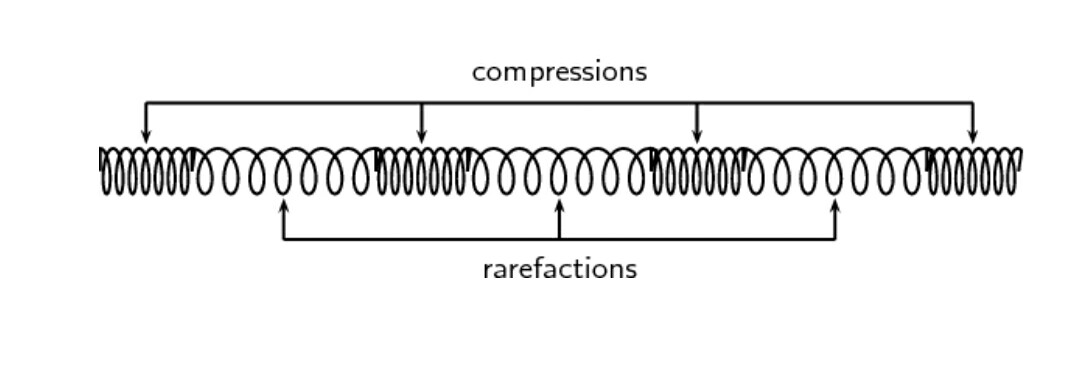
Sound wave is called longitudinal wave because it is produced by compressions and rarefactions in the air. The air particles vibrates parallel to the direction of propagation.
Question:17) (a) List two human activities responsible for the pollution of water bodies.
(b)Mention any two harmful effects of water pollution on aquatic organisms.
Solution:(a) The activities which may be polluting the water bodies are:
1)Disposal of garbage or sewage from cities/towns and from factories, Overuse of chemical fertilisers.
2) Release of hot water from the industries which may disturb the temperature of water body by disturbing the BOD.
(b)Harmful effects of water pollution on aquatic animals are:
1)Destruction of Marine ecosystems by solid and chemical wastes in water.
2)Death of aquatic animals which results in disturb in food chain.
Question:18) What is soil? State its main constituents. List any two practices that are followed for preventing or reducing the soil erosion.
Solution: Soil is a mixture of minerals, broken stones, decaying organic matter,plants, humus etc.
The formation of soil takes place in the following ways:
1) Rocks near the surface of Earth are broken down by various physical, chemical and some biological processes. This process takes millions of years.
2)This weathering leads to the formation of fine particles called soil.
3) Following are the some other factors responsible to the formation of soil
(a) Cracking and breaking down of rocks by sun heat that causes them into small particles.
b) Water dissolves rocks by freezing and fast flowing.
c) Wind causes erosion of rocks by fast blowing.
d)Lichens and mosses grow on rock surfaces and break them into powder down and form a thin layer of soil.
Removal of top layer soil is known as soil erosion. It is rich in humus and nutrients.
#Following are the Practices Used For preventing or reducing the soil erosion:
)Afforestation
2)Contour Ploughing
3)Step (terrace) Farming
4)Reduce Overgrazing
5) Mulching
Question:19) Explain Rutherford a – particle experiment on the following headings-
i) Observations (any two)
ii) Conclusions (any two)
iii) One important drawback of Rutherford model.
Solutions:
(i)Observations:
1) Most of the fast moving particles passed straight through the gold foil.
2) Some of tbe alpha- particle were deflected by the foil by small angles.
3) Suprisingly one out of every 12,000 alpha particles appeared to rebound.
ii)Conclusions:
1)Most of the space inside the atom is empty because most of the alpha-particles passed throgh the gold foil withoit getting deflected.
2) Very few particles were deflected from their path indicating that the positive charge of the atom occupies very little space.
Rutherford also give information about:
1)An atom consists of a positively charged center in the atom called the nucleus. The mass of the atom is contributed mainly by the nucleus.
2)The size of the nucleus is very small as compared to the size of the atom.
(iii)Drawbacks or Limitations of Rutherford Model are:
1) It failed to explain the stability of an atom.
2) It doesn’t explain the spectrum of hydrogen and other atoms.
Or
Question:19)
(i) Draw a labelled sketch of Bohr’s model of an atom with three shells having 13 electrons.
(ii) On the basis of Thomson’s model of an atom, explain how the atom is neutral as a whole.
(iii) If Z = 3 ,what would be the valency of the element? Also name the element.
Solution:(i)Bohr’s Model of an atom.
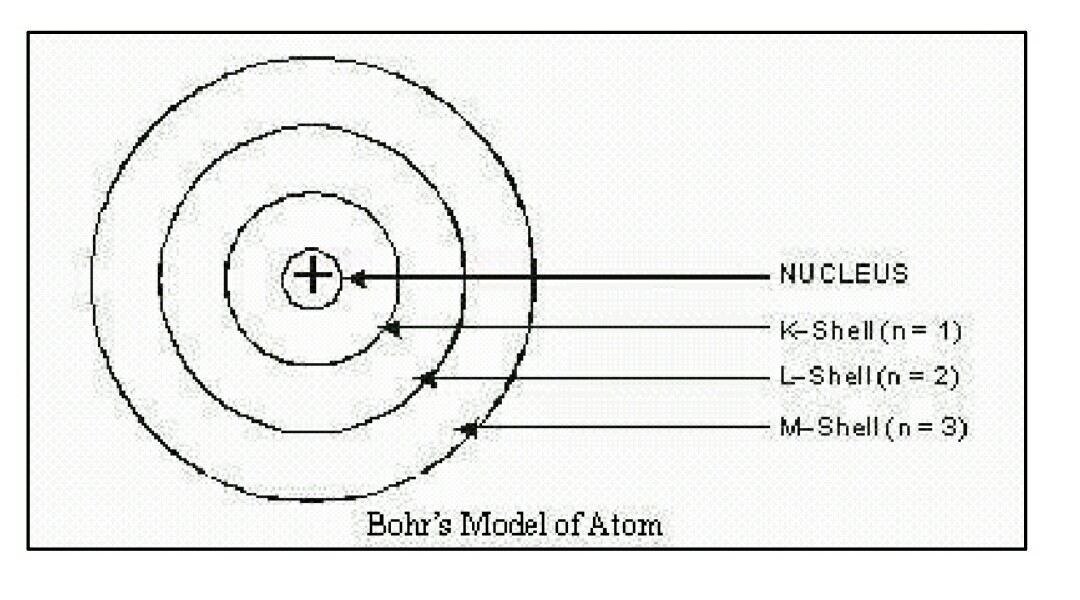 Atomic no. Of element= 13
Total no. Of orbits or shells=3
ELECTRONIC CONFIGURATION: 2,8,3
Valence Electrons = 3
Valency = 3
(ii)Thomson’s Model Of An Atom
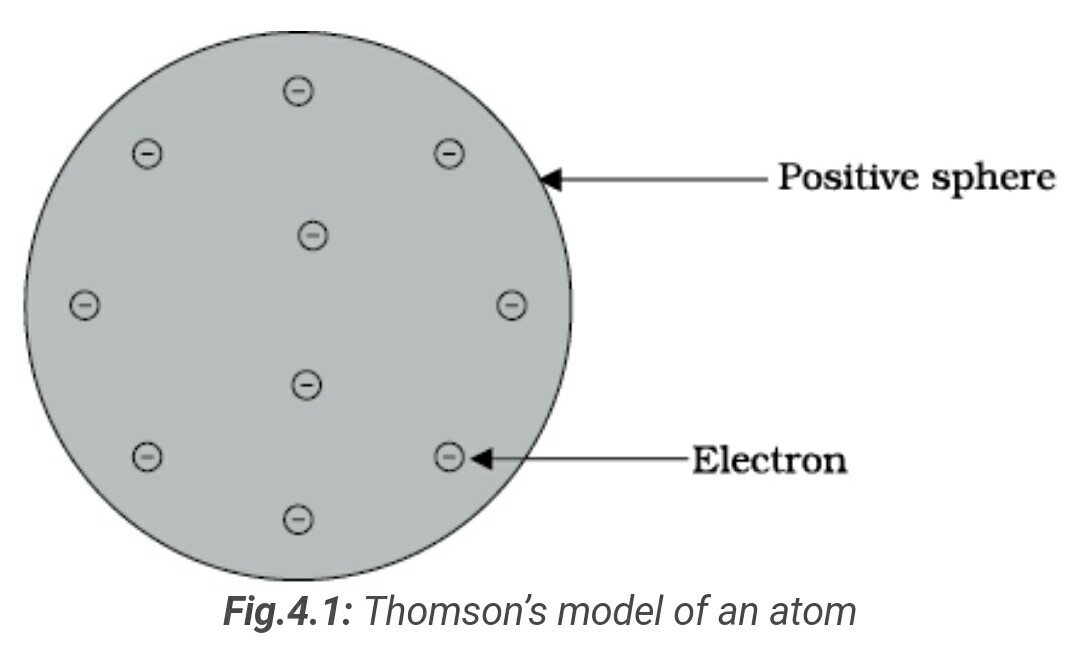
As per Thomsons model of the atom, an atom consists both negative and positive charges which are equal in number and magnitude. So, they balance each other as a result of which atom as a whole is electrically neutral.
(iii) Since ,
Z= 3 , Which is the Atomic no. Of Lithium.
EC – 2,1
Valency = 1
Question:20) (i)State in tabular form the method of transmission of each of the following diseases.
(a) Cholera (b) HIV-AIDS (c) Malaria d) Pneumonia
(ii) What are the different means by which infectious diseases are spread?
(iii) Expand AIDS and HIV.
Solution: (i)Table
DISEASES. MODE OF TRANSMISSION
Cholera. Contaminated drinking water
HIV-AIDS. Blood Transfusion, Sexual contact, Infected Syringes
Malaria. Vector animals, Stagnant water in place of living.
Pneumonia. Through air by coughing and sneezing of infected person.
(ii) Infectious diseases spread by following means are:
a) Through air: An infected person when sneezes or coughs releases droplets containing germs which infect another healthy person through air and microbes enter a new body.For example: common cold, pneumonia and tuberculosis.
b) Through water: contaminated water will infect many people and make them ill.
For example: cholera, amoebiasis, hepatitis spread through water.
c) Through sexual contact: Some diseases like AIDS and syphilis, etc., are transmitted by sexual contact. Other than this, AIDS virus also spread through blood, infected syringes, infected mother to her baby during pregnancy and through breast feeding.
d) Through vectors: There are some animals which act as intermediaries or vectors for a particular diseases. The vectors carry diseases from infected person to the healthy person. For example, mosquito spread malaria causing organism in humans, while sucking their blood.
(iii) Acronym of:
AIDS =ACQUIRED IMMUNO– -DEFICIENCY SYNDROME
HIV = HUMAN IMMUNO-DEFICIENCY VIRUS
Or
Question:20)
(i)Define health according to WHO. What are the good conditions for good health?
(ii) State the difference between acute and chronic diseases?
Solution:
(i)According to World Health Organisation,
“Health is defined as a state of complete physical, mental and social well being and not merely the absence of diseases or infirmity”.
# Following are the conditions for good health:
a) Social environment.
b) Public cleanliness.
c) Good economic conditions and earnings.
d) Social equality and harmony.
e) Having good food (balanced diet)
f) Personal and public hygiene maintenance.
Difference B/W Acute and Chronic Diseases
Acute Diseases:
1) Acute diseases lasts for short period of time.
2) Do not cause long term health problems.
3) For Example – Diarrhoea,Cold, cughing n sneezing, fever etc.
Chronic Diseases:
1) Chronic diseases lasts for long period of time, sometimes it lasts for life time.
2) These diseases have serious long term health problemsCancer etc.
3) For Example – Diabetes, Tuberclosis etc.
Question21: Define potential energy. Derive an expression for the gravitational potential energy of an object of mass ‘m’ at a height ‘h’ above the Earth’s surface. A ball of mass 0.25 kg is moving horizontally with a uniform velocity of 25m/s. Calculate kinetic energy possessed by a ball.
Solution: Potential Energy : Potential energy is the energy stored in an object as the result of its vertical postion or height . The energy is stored as the result of gravitational attraction of the earth for the object.
Ep = mgh
#Derivation: For Gravitational Potential Energy
We know that every object on the surface of the earth is attracted by the earth.
So, if an object has a mass mass ‘m’.
it will experience a force ,which is the weight of the object acting in vertically downward direction.
Suppose this object moves in vertically upward direction of height ‘h’ by a force ‘F ‘.
We know that,
F = mg ——-(1)
Therefore, W = F×h,
but ,F= mg (from eqn. 1)
So, W = mgh——–(2)
This work done upto height ‘h’ is known as Gravitational potential energy. Then,
(Ep) = w———(3)
from eqn 2 and 3, we get
Ep = mgh
Numerical:
Now,
Given,
Mass of the ball(m) = 0.25 kg
Velocity of the ball (v) = 25 m/s
Now, we know that
Kinetic Energy (Ek) = 1/2 mv^2 = 1/2 × 0.25 × 25 = 3.125 J
Or
Question:21) State the law of conservation of energy. Define power. Calculate the power of a pump which lifts 100 kg of water to a water tank placed at a height of 20m in 10 seconds. Given g= 10 m/s^2
Solution :
Law of conservation of Energy state’s that
” Energy can neither be created nor destroyed, but it can be change from one form to another”.
Power is the rate of doing work. It is the amount of energy consumed per unit time . Its SI unit is Watt or J/s.
Numerical:
Given,
Mass of water = 100 kg
Height of the water tank = 20 m
Time taken by pump to fill the tank=10s
Now, we know that ,
Potential energy ( Ep )= mgh = 100×10×20 = 20000 J
Power (P) = Energy/time. = 20000J/10s. = 2000 J
Question:22)(i) On what principle Lactometer and hydrometer are based.
(ii) A bucket of water is easily lifted as long as it is in water. Why?
(iii) When the object is immersed in fluid, name the two forces acting on it.
Solution:(i)Lactometers, which are used to determine the purity of a sample of milk and hydrometers used for determining density of liquids, are based on Archimedes principle.
(ii) When bucket is immersed in water feels light because of an upward buoyant force which is acting in the direction of muscular force. This upward buoyant force reduce the effective weight of the bucket. Hence feels lighter.
(iii) Objects immersed in fluid experiences following two forces,
Wt. of the object = mg(acts downwards)
Buoyant force (Acts Upwards)
Or
Question:22)(i) Why does a boat float but a nail made of same material sink?
(ii) Why does a block of plastic released under water comes up to the surface?
(iii) What do you understand by relative density? Give its formula.
Solution:(i)A steel nail sinks in water because the weight of water displaced by it is less than the weight of nail While boat made of same material steel does not sink because the shape of boat allows to displace large amount of water, which is equal or more than the weight of the boat.Hence boat can float.
(ii)The density of plastic is less than that of water, so the force of buoyancy on plastic block will be greater than the weight of the plastic block displaced. Hence the acceleration of plastic block will be in upward direction, and comes up to the surface of water.
(iii)Relative density- The ratio b/w density of a substance and density of water is called relative density.
Relative density of substance =( Density of substance)/(Density of water)
Question:23) Derive the expression for kinetic energy.
Solution:
Let ‘m’ be the mass of an object moving with a velocity ‘v’. Therefore Workdone by the object,
We know that,
Work done = Force × displacement
W = F × s———–(1)
But, Force (F) = m×a
Put the value of ‘F’ in eqn. (1), We get
W = m×a×s————(2)
Now, By 3rd equation of motion,
v² = u² + 2as
When the object is at rest,
u = 0 m/s
Therefore,
v² = 2as
or, as = v²/2———(3)
Put the value of eqn.(3) in eqn.(2),We get
W = mv²/2 =1/2 mv²
Since, workdone is stored in kinetic energy
Therefore,
Kinetic Energy (Ek) = 1/2 mv²


 Apex Class
Leave a comment